
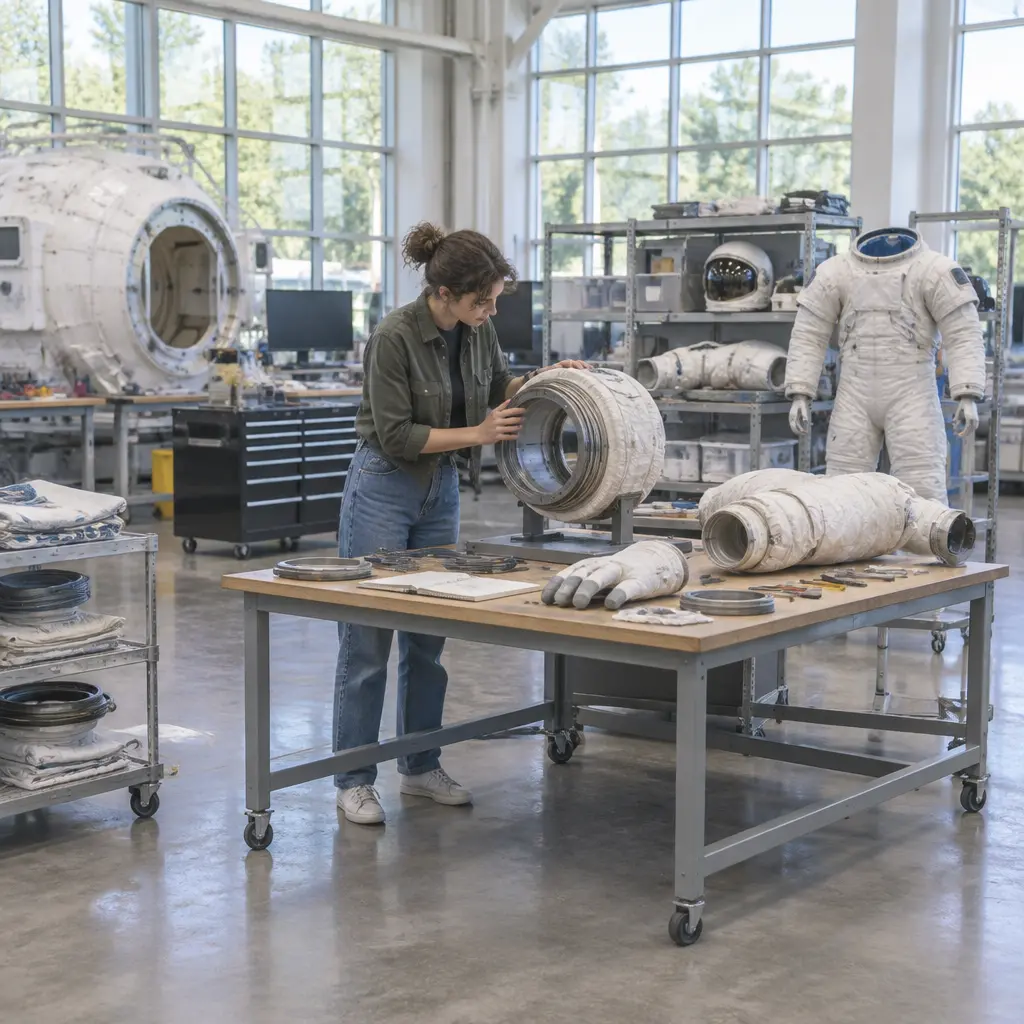
Space-suit mobility engineering is the design of pressure-retaining garments and joints that let astronauts move and work in vacuum, where an unprotected human body cannot survive. Its central challenge is balancing pressure integrity—the suit’s ability to contain life-supporting gas—against joint flexibility, which determines how much effort and range of motion tasks require. NASA’s current spacesuit work illustrates why the trade matters: a suit must maintain a pressurized, life-supporting environment while enabling activities such as walking, reaching, and handling tools. This article explains pressure and mobility fundamentals, the main joint and bearing designs, the effects of suit fit and task demands, and how testing and operational experience guide engineering decisions.
Pressure integrity defines the space-suit mobility problem
Pressure integrity is a suit’s capacity to contain its internal atmosphere without unacceptable leakage, structural failure, or loss of life-support function. NASA’s spacesuit engineering materials describe the suit as a personal spacecraft: its pressure garment must provide a habitable environment while protecting the wearer from the vacuum and other hazards of space. The garment’s pressure load tends to make flexible sections balloon outward, increasing resistance to bending and changing the suit’s shape around the astronaut.
This trade is not simply “strong material versus soft material.” Engineers must manage gas pressure, restraint layers, joint geometry, fit, thermal protection, and the work an astronaut must perform. A suit that holds pressure but is too difficult to move in can increase fatigue and limit task performance; a highly flexible design that cannot reliably contain pressure is not viable. The appropriate design therefore depends on the mission, operating environment, and required movements.
Pressure garment and restraint layer
A pressure garment is the gas-retaining portion of a spacesuit. Because a pressurized flexible envelope would otherwise expand and become balloon-like, suit designs use restraint structures to control its dimensions. NASA’s suit descriptions distinguish the pressure bladder, which contains gas, from the restraint layer, which helps maintain the intended shape and carries loads. Thermal and micrometeoroid protection are separate functional layers in many suit architectures.
These layers interact: restraint must be strong enough to resist pressure-driven expansion, yet shaped so the wearer can bend and reach. Seams, closures, interfaces, and joints are also potential design and inspection concerns. Engineers therefore evaluate the complete garment assembly rather than treating its pressure bladder as an isolated component.
Pressure, force, and mobility
Pressure is force distributed over an area, so a pressurized suit imposes mechanical loads on its fabric and joint systems. As the wearer moves, joint geometry can deform the pressure envelope, while the restraint structure and bearings must guide that deformation. The result is a coupled engineering problem: the suit must preserve its pressure boundary while limiting the effort needed to move.
There is no single mobility statistic that describes every suit. Range of motion, torque or resistance, task completion time, fatigue, and pressure stability measure different aspects of performance. NASA’s human-in-the-loop testing approach is important because a joint that moves freely in a bench test may still be uncomfortable or ineffective when worn during realistic tasks.
Mechanical joints and bearings improve space-suit mobility
A spacesuit joint is a pressure-retaining region engineered to permit controlled motion. NASA and spacesuit designers use multiple approaches, including soft fabric joints, mechanical bearings, and hybrid arrangements. Their shared purpose is to manage the suit’s pressurized shape and reduce resistance while preserving structural and pressure integrity.
Joint selection depends on where movement is needed. Shoulders and elbows support reaching and tool use; hips and knees matter for climbing, crouching, and walking; wrists and gloves must balance dexterity with protection. Since these body regions have different motion patterns and load demands, one joint architecture is not necessarily suitable throughout a suit.
Soft and convoluted joints
A soft joint uses shaped fabric and restraint elements to accommodate movement without relying on a rigid rotating bearing. Convolutes—folded or bellows-like sections—can provide space for a pressurized garment to bend. Their performance depends on fold geometry, material behavior, restraint design, and alignment with the wearer’s anatomical joint.
Soft joints can be useful where low mass and a broad range of motion matter, but their resistance may vary with posture and direction. Designers must prevent excessive folding, pinching, or pressure-driven displacement while ensuring the joint returns predictably through repeated movement. Testing across different body sizes and movement patterns helps reveal fit-dependent problems.
Rotational bearings and hard upper torsos
A mechanical bearing enables rotation between suit sections while helping maintain a sealed pressure boundary. Bearings can be used at locations such as the waist, shoulder, or wrist, depending on the suit design. A hard upper torso is a rigid shell that provides a structural interface for the helmet, arms, and life-support connections; it can reduce reliance on a fully fabric torso but requires carefully designed interfaces for mobility.
The trade-off is between controlled rotation and added mechanical complexity, mass, and interface demands. A bearing’s axis must suit the movement it is intended to support. If the axis or fit is poorly matched to the astronaut, the wearer may compensate with other body movements, raising effort or restricting task performance. Bearing integration is therefore assessed as part of the whole suit, not as an independent hardware choice.
Hybrid joints and task-specific mobility
Hybrid joints combine soft and mechanical elements to distribute motion across a joint region. For example, a bearing may provide rotation while fabric sections accommodate bending or connect the bearing to the rest of the pressure garment. This approach can target mobility where a task requires it without making every suit section mechanically complex.
The engineering objective is task capability, not maximum motion in every direction. A planetary surface suit may prioritize walking, kneeling, and recovering from a fall, while an orbital servicing suit may emphasize reaching, restraint, and tool operation. Mission-specific requirements help teams decide where to add mobility, where to accept resistance, and how to validate the final configuration.
Fit, gloves, and human factors shape practical mobility
Fit is the relationship between the suit’s dimensions and the astronaut’s body. A suit can meet structural requirements yet perform poorly if its joint centers, limb lengths, or interfaces do not align with the wearer. Fit affects posture, force transmission, visibility, comfort, and the ability to reach work areas; it is therefore a core engineering variable rather than a final tailoring detail.
Sizing and joint alignment
Joint alignment describes how closely the suit’s engineered pivot or flex region corresponds to the wearer’s anatomical joint. Misalignment can cause the suit to resist movement or shift loads onto neighboring body regions. Adjustable components and a range of suit sizes can improve fit, but each configuration still needs verification with representative users and tasks.
NASA’s long history of extravehicular activity has made fit and sizing operational concerns, not merely comfort considerations. Mission planning must match astronauts to suit hardware and confirm that the selected configuration supports required tasks. In future programs, designs intended for a broader astronaut population need to demonstrate usable fit and performance across that population rather than assume a single body shape.
Glove dexterity and hand fatigue
A spacesuit glove is a pressure garment for the hand, where small movements are essential for operating tools, connectors, and controls. Pressurization and protective layers can make finger flexion demanding, while glove fit affects contact, grip, and tactile feedback. The hand is especially sensitive to a poor balance between protection and dexterity because many EVA tasks require repeated fine-motor actions.
Glove assessment should measure more than whether an astronaut can close a hand. Engineers examine task completion, grip and pinch performance, comfort, pressure-related resistance, and fatigue during repeated work. Gloves illustrate the broader suit principle: mobility is useful only when it supports the required human task safely and consistently.
Workload, posture, and fatigue
Workload is the physical and mental effort required to complete a task. Suit resistance can increase muscular demand, and awkward postures can compound the effect. Over a long extravehicular activity, repeated reaching, gripping, and repositioning may make modest resistance consequential, so engineers evaluate task sequences and duration as well as isolated movements.
Human-factors data can guide changes to joint geometry, glove design, restraint patterns, and procedures. A design that performs well for one brief movement may not remain effective over a full work period. For this reason, realistic simulations and astronaut feedback complement quantitative measurements.
Testing validates pressure integrity and joint flexibility
Spacesuit testing combines pressure verification with mobility and human-performance evaluation. Pressure checks assess the garment’s ability to maintain its sealed environment, while mechanical tests examine joint motion, resistance, durability, and behavior under repeated loading. Human-in-the-loop trials determine whether those properties translate into useful performance.
Pressure and leak testing
Leak testing checks whether gas escapes through the pressure garment, seams, closures, or interfaces at an unacceptable rate. Proof and structural tests can assess whether components withstand specified pressure loads, while inspections look for wear, damage, or degradation. Requirements and acceptance limits are program-specific, so results must be interpreted against the applicable suit specification rather than a universal threshold.
These tests are essential but do not establish mobility by themselves. A suit may pass a pressure test and still be difficult to use. Conversely, a design change intended to ease movement must be checked to ensure it has not weakened a pressure boundary or created new wear points.
Range-of-motion and resistance testing
Range-of-motion testing measures how far a joint or body segment can move in specified directions. Resistance testing measures the force or torque needed to produce that movement. Together, these methods help engineers compare design options, identify motion restrictions, and locate high-effort regions.
The results depend on test configuration: suit pressure, fit, posture, and measurement method all matter. A useful evaluation therefore records conditions and links measurements to operational tasks. Graphs can show joint angle against applied torque, while task charts can compare completion time, errors, and perceived effort across suit configurations.
Neutral-buoyancy and analog testing
Neutral-buoyancy testing uses a water tank to approximate aspects of weightlessness by balancing an object’s weight with buoyant force. NASA’s Neutral Buoyancy Laboratory supports simulated spacewalk training and evaluation, allowing astronauts to rehearse tasks in a spacesuit-like environment. Water does not reproduce every feature of space: drag and buoyancy differ from vacuum, and thermal and surface conditions are not identical.
Other analogs, including reduced-gravity aircraft, planetary field trials, and laboratory task simulations, address different parts of the problem. Combining methods provides a more credible assessment than relying on a single environment. Operational feedback from actual spacewalks then adds evidence about how equipment performs under mission conditions.
Mission history and future suit programs show the trade in practice
Spacesuit mobility requirements have changed as missions have shifted from spacecraft operations to orbital construction and prospective planetary exploration. NASA’s Apollo lunar surface suits had to support walking and field work, while the Extravehicular Mobility Unit used for many spacewalks on the International Space Station is designed for orbital operations. These examples show why suit engineering is mission-specific rather than a search for one universally optimal garment.
Apollo and the need for surface mobility
Apollo astronauts needed suits that protected them on the lunar surface while permitting walking, bending, sample collection, and tool use. NASA’s Apollo mission records document six crewed lunar landing missions, from Apollo 11 in 1969 through Apollo 17 in 1972. The experience demonstrated that surface mobility must be designed around actual geology tasks and movement, not simply survival in a pressure environment.
Lunar gravity is about one-sixth of Earth’s gravity, but that does not eliminate suit resistance or make movement effortless. Pressurized joints, restrictive fit, and task posture still affect performance. Apollo operations also produced practical lessons that informed later suit concepts and the continued study of improved joint mobility.
International Space Station EVA and operational validation
The International Space Station’s Extravehicular Mobility Unit has supported assembly, maintenance, and repair work in orbit. NASA describes an EVA suit as a self-contained system that supplies life support and protection while enabling an astronaut to work outside a spacecraft. The repeated use of the EMU provides a substantial operational record, while also underscoring the need for maintenance, inspection, fit management, and ongoing assessment.
Orbital work emphasizes stable positioning, reach, restraint, and tool operation. Those demands differ from walking across a planetary surface, where lower-body mobility and recovery from falls become central. Operational experience is most useful when interpreted in relation to the task environment and the suit configuration used.
Artemis and next-generation exploration suits
NASA’s Artemis-era exploration suit development, including the Axiom Extravehicular Mobility Unit program, reflects the need for suits that support future lunar surface missions. NASA has described next-generation suit work as intended to improve fit, mobility, and operational capability compared with legacy hardware. Program designs and schedules evolve, so specific performance claims should be checked against current agency and contractor updates.
Future planetary suits must integrate pressure containment with walking, kneeling, climbing, sampling, and tool use, while also accommodating dust, thermal extremes, and long-duration operations. The design path is iterative: define mission tasks, develop joint concepts, test pressure and mobility, evaluate users, and revise the hardware. Figure suggestion: a comparative diagram could map orbital EVA and lunar surface tasks against the joint ranges, glove functions, and pressure-system requirements each places on a suit.
Conclusion: pressure integrity and flexibility must be engineered together
Space-suit mobility engineering balances a reliable pressure boundary with movement that supports useful work. Pressure garments and restraint layers control expansion; soft, bearing-based, and hybrid joints distribute motion; fit, gloves, and workload determine whether that motion works for a person; and pressure, mechanical, analog, and operational testing validate the design.
The broader implication is that suit performance cannot be judged by pressure integrity or flexibility alone. It must be evaluated against the mission, astronaut, and task as an integrated system. Readers interested in the engineering should consult NASA’s spacesuit and EVA resources, review human-in-the-loop testing methods, and follow current Artemis suit program updates to see how requirements and designs continue to develop.
Sources: NASA, Spacesuits, https://www.nasa.gov/humans-in-space/spacesuits/; NASA, Extravehicular Mobility Unit (EMU), https://www.nasa.gov/reference/extravehicular-mobility-unit/; NASA, Neutral Buoyancy Laboratory, https://www.nasa.gov/johnson/space-center/neutral-buoyancy-laboratory/; NASA, Apollo 11 Mission Overview, https://www.nasa.gov/mission/apollo-11/; NASA, Axiom Space Selected to Develop Next-Generation Spacesuits for Artemis, https://www.nasa.gov/news-release/nasa-selects-axiom-space-to-develop-next-generation-spacesuits-for-artemis/.