A spacesuit’s ability to protect an astronaut after years of use is assessed through a planned sequence of inspections, pressure and leak tests, component checks, and reviews of its maintenance history. NASA does not treat a suit as safe merely because it looks intact: engineers compare measured performance with acceptance limits and investigate signs of wear in seals, fabrics, joints, valves, and life-support connections. The checks matter because a suit is a miniature spacecraft—NASA’s Extravehicular Mobility Unit (EMU) operates at a pressure far below sea-level atmospheric pressure, while supporting breathing, cooling, communications, and mobility. This article explains what “still works” means, how engineers test aged suits, which parts demand special attention, and how NASA’s history with suit wear informs present-day maintenance.
Suit serviceability defines whether a spacesuit remains safe to use
Suit serviceability is the documented determination that a suit and its associated life-support equipment continue to meet specified safety and performance requirements for an intended mission. NASA’s technical standards and maintenance practices frame this as a system-level judgment, not a single pass/fail check: pressure containment, breathing-gas delivery, thermal control, communications, electrical functions, and crew fit must work together. The relevant “age” is therefore not simply the number of years since manufacture. Usage, storage conditions, exposure to contaminants, repairs, and accumulated operating hours all influence condition.
For context, NASA describes the EMU as operating at about 4.3 pounds per square inch (psi), compared with roughly 14.7 psi of atmospheric pressure at sea level. That pressure difference makes small leaks and degraded seals significant. A spacesuit also has to preserve a stable oxygen environment and remove metabolic heat; a pressure shell that holds air but cannot cool an astronaut is not serviceable. Engineers consequently combine separate tests into a traceable safety case, linking results to the specific suit configuration and planned use.
The principal categories are pressure integrity, component and material condition, and functional performance. Each answers a different question: Does the suit retain pressure? Are its parts still structurally sound? And can the complete system perform its job under realistic conditions?
Pressure integrity means keeping the suit’s internal environment contained
Pressure integrity is the ability of the pressurized assembly to retain gas within prescribed limits. Engineers configure the suit for a pressure check, connect it to calibrated instrumentation, raise it to the required test condition, and monitor pressure change over a defined period. The procedure may include isolating sections or checking interfaces separately so that a leak can be traced to a glove, wrist bearing, hose, connector, or other boundary. NASA’s public descriptions of suit operations explain the need for leak checks before use, while exact acceptance limits and procedures depend on the hardware configuration and approved maintenance documentation.
A pressure test is not simply “inflate it and see.” Temperature changes can alter pressure readings, and instruments themselves have measurement uncertainty. Technicians therefore control test conditions, use calibrated equipment, record the starting and ending readings, and assess the result against the applicable limit. If a test fails, engineers locate and repair the leak, then repeat the required verification rather than relying on visual inspection alone.
Condition inspections identify aging before it becomes a leak
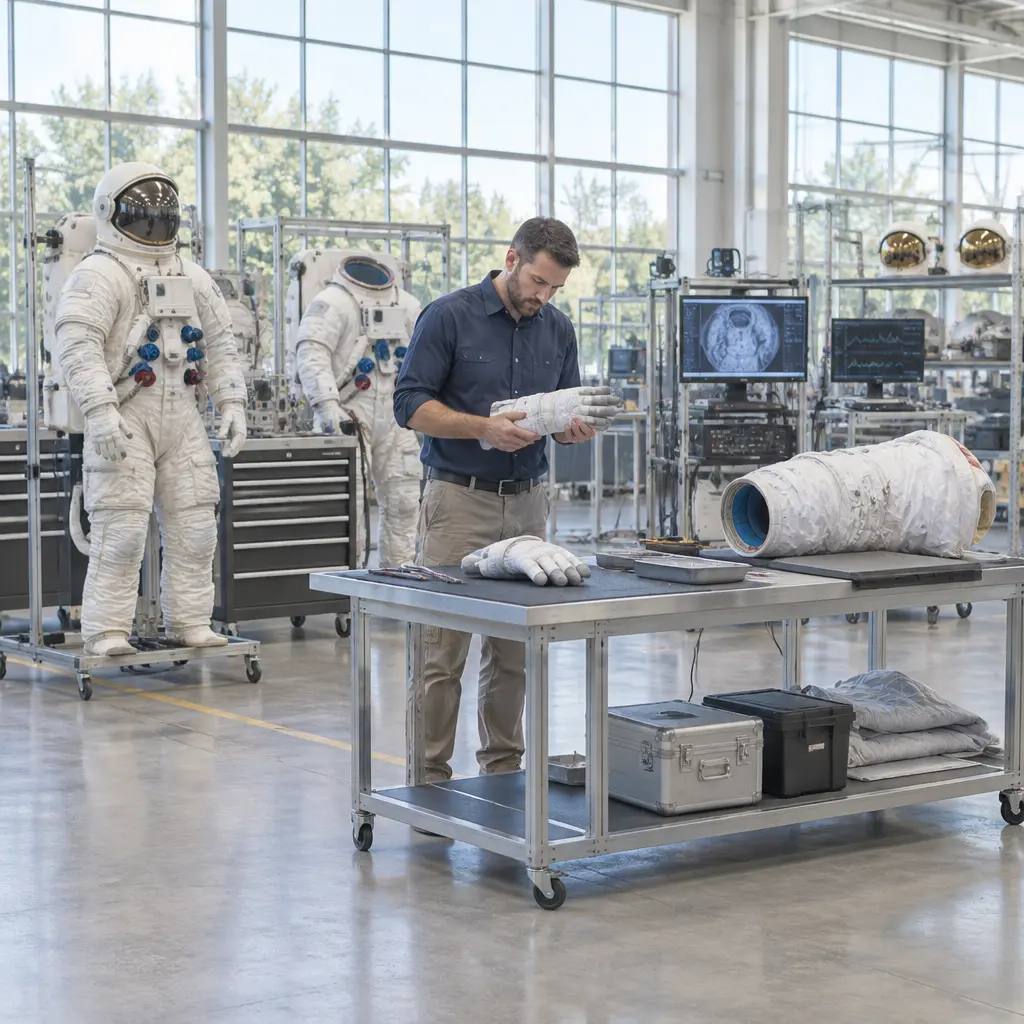
Condition inspection is the examination of materials and hardware for deterioration, damage, contamination, or changes that could affect performance. Inspectors look for cuts, abrasion, delamination, discoloration, fraying, stiff or tacky areas, damaged stitching, corrosion, and wear around high-stress locations. They pay particular attention to flexible joints and interfaces, where repeated bending and handling can concentrate loads. Some defects are visible; others require magnification, measurements, or approved nondestructive inspection methods.
An inspection record is meaningful only when compared with prior records. Engineers track repairs, part replacements, operating history, and known exposure events to detect trends—for example, a seal that is becoming less elastic or a joint that is developing increasing resistance. NASA’s spacesuit maintenance documentation is configuration-specific, so a generic age limit cannot substitute for the suit’s official history and inspection criteria.
Aging spacesuit components are tested according to how they can fail
Spacesuit aging is the gradual change in a material or component’s properties through use, storage, environmental exposure, and repeated mechanical loading. Engineers organize examinations around failure modes: pressure loss, restricted movement, loss of cooling, electrical interruption, or degraded breathing-gas delivery. That approach connects a visible defect to its operational consequence, helping teams decide whether a part can remain in service, needs repair, or must be replaced.
Pressure garments and seals are checked for wear and leakage
The pressure garment is the flexible enclosure that helps contain the suit’s pressurized atmosphere. Its fabrics, seams, closures, and seals are checked for damage and then evaluated through pressure-retention procedures. Seals receive special scrutiny because they must remain flexible enough to maintain contact while tolerating assembly, donning, movement, and repeated servicing. A seal that appears smooth can still fail to perform, which is why physical inspection and pressure verification complement one another.
The distinction between an outer cover and a pressure-retaining layer is also important. A scuff on an outer protective layer does not automatically mean the pressure boundary has failed, but it can expose underlying material to additional wear. Engineers assess the affected layer, the location, and the approved repair criteria before deciding whether the suit remains usable.
Joints, bearings, and gloves are assessed for mobility and fit
Mobility checks determine whether the wearer can move safely while the suit is pressurized. Engineers or suited test subjects evaluate joint bearings, shoulder and hip areas, wrist components, and gloves for smooth motion, unwanted binding, excessive play, and correct range. They may use operational evaluations or instrumented measurements, depending on the suit and test plan. A component can hold pressure but still be unacceptable if it makes a required task too difficult or increases crew fatigue.
Gloves merit particular attention because they combine a pressure boundary with fine-motor work. Inspectors check fingertips, seams, restraint layers, and interfaces, while functional evaluations can include handling representative tools or controls. NASA’s experience with spacewalk hardware shows why this matters: glove wear and comfort have been persistent engineering concerns, and the agency has adjusted inspection, sizing, and maintenance practices as suit designs and mission demands evolved.
Life-support and thermal-control equipment must function as a system
The portable life-support system supplies and circulates breathing gas, removes carbon dioxide, manages moisture, provides cooling, and supports communications and power. Engineers test individual components and integrated functions, including fans, valves, regulators, sensors, electrical connections, and the liquid-cooling garment circuit. Functional checks verify that readings are plausible and that control responses occur as expected; component-level results are then considered alongside the assembled system’s performance.
Thermal control is especially important because a suited astronaut generates heat during work. NASA’s descriptions of the EMU explain that a liquid-cooling garment circulates water through tubing to carry heat away from the body. Thus, a successful pressure check alone cannot establish readiness: cooling flow, ventilation, gas quality, alarms, and communications must also be verified under the applicable test procedure.
Suit verification combines bench tests, operational checks, and records
Verification is the process of demonstrating with documented evidence that equipment meets its requirements. For a mature spacesuit, engineers use multiple kinds of evidence because no single test reproduces every hazard. Bench testing isolates components, integrated testing checks interactions, and operational evaluations reveal handling or fit problems. Results are interpreted with the suit’s configuration, repair history, and intended mission in view.
Bench testing isolates faults in individual assemblies
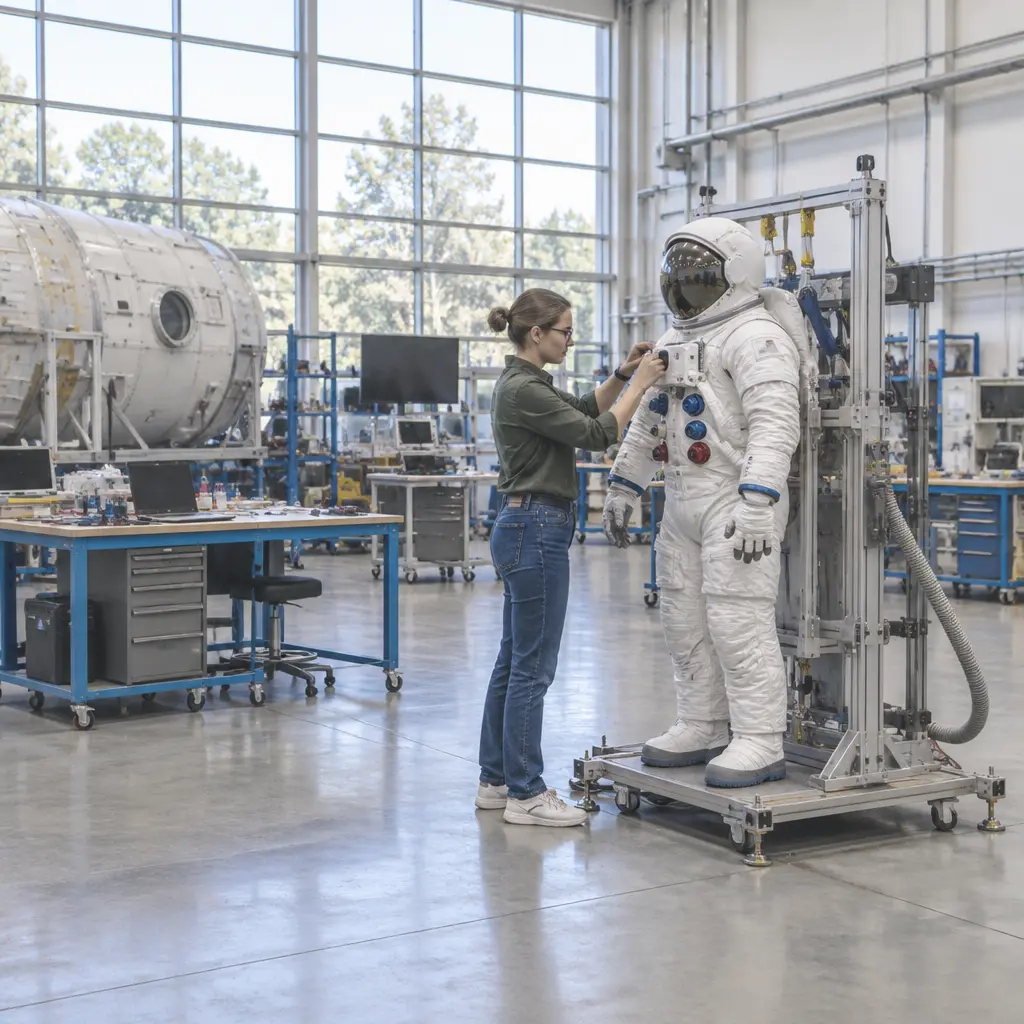
Bench testing evaluates a component or assembly outside normal crew operations. A technician may check a valve’s movement, a regulator’s output, a connector’s continuity, a sensor’s response, or a bearing’s mechanical behavior with calibrated tools. Isolation makes troubleshooting more efficient: if a complete suit test detects a problem, component-level tests can help establish whether its source is a particular part or an interface between parts.
Test equipment must itself be maintained and calibrated. Otherwise, an apparent suit failure—or an apparent pass—could reflect an inaccurate gauge, sensor, or test setup. Quality records therefore identify the hardware tested, the measurement equipment used, the procedure revision, the results, and any corrective work.
Integrated and suited evaluations check real-use performance
An integrated evaluation checks whether suit components work together, while a suited evaluation adds the human wearer and mission-like tasks. These tests can reveal issues that a bench cannot: awkward reach, glove interference, restricted visibility, difficulty operating a connector, or discomfort that affects task performance. NASA’s Neutral Buoyancy Laboratory, a large underwater training facility, is used to rehearse spacewalk tasks in a simulated weightless environment; such training is not a substitute for every engineering qualification test, but it illustrates how operational demands are evaluated in context.
Test teams set boundaries so that an evaluation does not expose a crew member to uncontrolled risk. The specific test sequence depends on the suit design, the issue under investigation, and the approved safety plan. If a discrepancy appears, the team records it, evaluates its severity, and determines whether further inspection, repair, retesting, or restriction is required.
Maintenance history turns individual results into an aging assessment
Aging assessment is the review of a suit’s accumulated evidence over time, rather than a judgment based only on the latest test. Engineers consider use cycles, exposure, repairs, replaced parts, inspection findings, and performance trends. This record supports decisions about continued use and helps identify components that deserve closer monitoring or scheduled replacement.
A useful record also preserves configuration: two suits with the same model name may differ because of upgrades, repairs, or component changes. NASA’s technical standards and safety processes emphasize controlled requirements and documentation because hardware must be evaluated against the configuration actually being prepared for flight.
Spaceflight history shows why repeated suit checks matter
The history of extravehicular activity (EVA) shows that suit reliability depends on both design and disciplined operations. Spacewalks expose suits to vacuum, temperature extremes, radiation, impacts from small particles, and repeated bending and servicing. Public NASA mission reports and suit-development histories document how operational observations feed back into inspection practices, component improvements, and procedures. The result is a lifecycle approach: experience from use informs the next round of tests and maintenance.
Long service life makes configuration control essential
A suit may remain in service through upgrades and repairs, but continued service does not mean every original component remains unchanged. Teams must know which parts are installed and which procedures apply to that configuration. This is particularly important when a repair changes materials, interfaces, or performance assumptions: engineers need evidence that the repaired assembly meets its requirements and remains compatible with the rest of the system.
For readers seeking a visual summary, a useful chart would map each test to the hazard it addresses: pressure-decay testing to leaks, joint checks to restricted mobility, life-support functional tests to gas and cooling failures, and record review to cumulative degradation. Such a chart should label the applicable suit configuration and avoid presenting one universal pass criterion, because NASA procedures and hardware requirements vary.
Operational anomalies trigger investigation, not assumptions
An anomaly is an unexpected observation or performance issue that warrants evaluation. A change in pressure, unusual resistance, a sensor discrepancy, or visible wear does not by itself prove that a suit is unsafe; it does require a documented investigation. Engineers compare the observation with test data, inspect related components, consider possible causes, and define corrective action. The suit is returned to service only after the applicable verification is completed and authorized.
This approach avoids two errors: treating every cosmetic mark as a failure, and dismissing a small change that could signal a developing problem. The engineering decision depends on evidence, risk, and the requirements for the mission—not appearance or age alone.
Conclusion: Spacesuit readiness is demonstrated through evidence
Spacesuit engineers determine whether a suit still works by combining pressure-integrity tests, material and component inspections, mobility evaluations, life-support checks, integrated trials, and maintenance-record reviews. The serviceability of a mature suit is a configuration-specific engineering judgment: years in storage or service matter, but measured condition and documented performance matter more. Because a suit must simultaneously retain pressure, support movement, deliver breathing gas, remove heat, and communicate, no single test can establish readiness.
For a broader view, consult NASA’s spacesuit and EVA technical resources and look for mission reports that explain how operational findings lead to design or maintenance changes. The central lesson is straightforward: continued use should be supported by repeatable tests, calibrated measurements, clear records, and authorized engineering review.
Sources: NASA, “Spacesuits,” https://www.nasa.gov/humans-in-space/spacesuits/; NASA, “Extravehicular Mobility Unit (EMU),” https://www.nasa.gov/reference/extravehicular-mobility-unit/; NASA, “NASA-STD-3001, Volume 2: Human Factors, Habitability, and Environmental Health,” https://standards.nasa.gov/standard/nasa/nasa-std-3001-vol-2; NASA, “Neutral Buoyancy Laboratory,” https://www.nasa.gov/johnson/neutral-buoyancy-laboratory/; NASA, “Spacewalks,” https://www.nasa.gov/missions/station/spacewalks/