
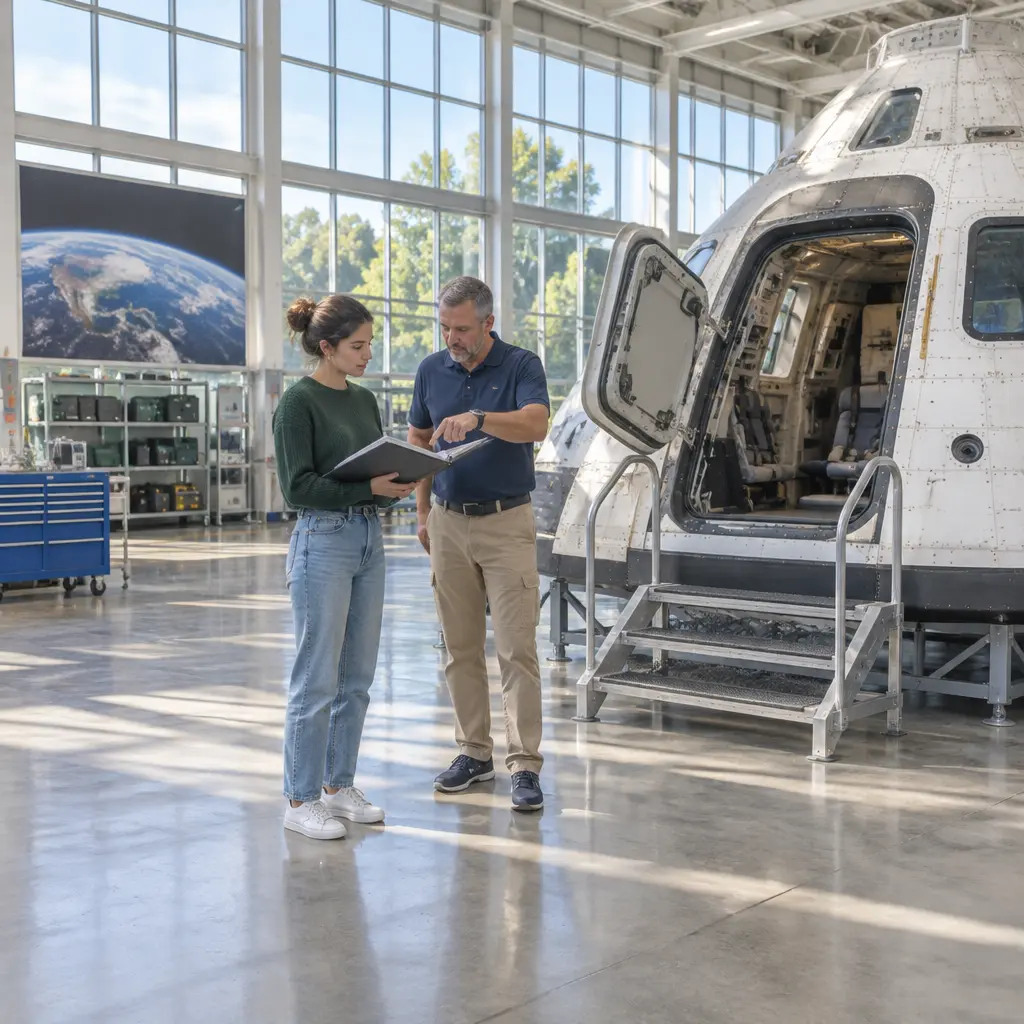
Commercial astronaut preparation adapts military protocols by retaining proven practices in risk management, crew coordination, and emergency response while removing assumptions that only fit career military personnel. Commercial astronaut preparation is the training and operational readiness process for people flying on privately operated spacecraft. It matters because the Federal Aviation Administration requires commercial human-spaceflight operators to train crew members for assigned duties, while the industry is expanding access to space beyond government astronaut corps. The strongest approach combines mission-specific instruction, medical and psychological screening, team-based simulations, and clear safety authority—without treating military experience as a prerequisite or a substitute for spacecraft-specific competence.
Commercial Astronaut Preparation Defines Adapted Military Protocols
Military-derived preparation is not a single standardized curriculum. It is a set of practices—such as disciplined briefings, checklists, leadership under pressure, and after-action reviews—reworked for commercial missions, mixed-experience crews, and each vehicle’s procedures. NASA’s astronaut training provides a useful reference point, but commercial operators remain responsible for preparing their own personnel and passengers for their specific missions.
The FAA’s commercial human-spaceflight framework distinguishes crew from spaceflight participants and places training obligations on operators. Under 14 CFR Part 460, operators must ensure crew members are trained for their assigned duties, including emergency procedures, and must inform participants in writing about the risks of launch and reentry. The rules do not create a universal military-style astronaut qualification or require every participant to complete the same training. This distinction is important: commercial preparation must be proportionate to the person’s role, the vehicle, and the mission.
A relevant measure of the sector’s growth is the FAA’s record of licensed and permitted commercial space operations, which has increased markedly over the past decade. These launches are not all crewed, but the growth reflects a more active commercial operating environment in which training systems must be repeatable, auditable, and tailored to different missions. For context, the FAA reported 148 licensed or permitted commercial space operations in fiscal year 2024, a record at the time of publication. That figure describes operations, not astronaut trainees or crewed flights.
Military Protocols as Adaptable Practices
A protocol is a repeatable method for performing a task or making a decision under defined conditions. Military organizations use protocols to coordinate teams, reduce avoidable error, and preserve decision-making when circumstances are stressful. In commercial astronaut preparation, useful examples include standard operating procedures, concise crew communication, checklists, clear role assignments, and structured debriefs.
These practices transfer best when they are treated as tools rather than cultural requirements. A commercial trainee may be a scientist, engineer, educator, investor, or professional pilot; prior service should not be assumed. Training should therefore teach the purpose behind each protocol, verify that the trainee can apply it, and avoid relying on military vocabulary or hierarchy that a mixed civilian crew may not share.
Commercial Crew and Spaceflight Participants
Commercial crew members perform duties on behalf of the operator, while spaceflight participants generally travel without serving as professional crew. The distinction affects training depth and responsibilities. Crew need role-specific proficiency in vehicle systems and emergency procedures; participants need enough instruction to understand their environment, follow safety directions, and respond appropriately to contingencies assigned to them.
The FAA’s informed-consent requirements emphasize that participants must be told about known hazards and the safety record of the vehicle. Informed consent is not a replacement for training or safety engineering. It is one part of a broader system that includes vehicle design, operational controls, medical considerations, and practiced procedures.
Risk Management and Crew Resource Management Shape Preparation
Risk management is the process of identifying hazards, estimating their likelihood and consequences, and selecting controls. NASA’s systems-safety approach and military risk-management traditions both emphasize identifying hazards before operations and reassessing them when conditions change. For commercial trainees, this means learning not just what a checklist says, but why a step exists, what abnormal conditions look like, and when to stop or ask for help.
Crew resource management (CRM) is a related discipline that helps teams use communication, leadership, situation awareness, and decision-making to reduce error. The U.S. Federal Aviation Administration developed and promoted CRM in aviation after investigations showed that technical skill alone could not prevent all accidents. Its relevance to spaceflight is practical: spacecraft crews also need to share information clearly, detect misunderstandings, and coordinate actions under time pressure.
Checklists, Briefings, and Closed-Loop Communication
A checklist is a job aid that prompts a team to verify critical steps in a defined sequence; it is not a substitute for knowledge or judgment. Pre-mission briefs can establish roles, decision authority, communication conventions, and contingency priorities. Closed-loop communication—where a direction is acknowledged and its completion confirmed—helps reduce ambiguity during time-sensitive tasks.
Commercial programs can validate these methods through observed exercises rather than attendance alone. Trainees can be assessed on whether they identify a hazard, state the relevant procedure, communicate their action, and confirm the outcome. The National Transportation Safety Board’s investigations across transportation modes repeatedly demonstrate how communication breakdowns and inadequate coordination can compound technical or operational problems; lessons should be translated into spacecraft-specific scenarios, not copied mechanically from aviation.
Risk-Based Training and Stop-Work Authority
Risk-based training allocates practice according to the severity and plausibility of hazards and the trainee’s responsibilities. A pilot, mission specialist, and short-duration participant do not require identical technical depth. All should, however, understand the hazards relevant to their role and know how to raise a concern. A clearly defined stop-work or pause-and-verify process can help prevent schedule pressure or status differences from silencing safety concerns.
The FAA’s commercial rules require operators to provide specified safety information and training, but they do not prescribe a complete universal curriculum. Operators therefore need documented training objectives, evaluation criteria, and records showing that each person is prepared for assigned tasks. This flexibility supports innovation while making transparent standards and independent review especially valuable.
Mission-Specific Simulation Builds Emergency Readiness
Simulation is the deliberate practice of tasks in a controlled environment that reproduces relevant vehicle, crew, or emergency conditions. Military services use simulators and field exercises to develop performance under stress; commercial astronaut programs can adapt the method through spacecraft mock-ups, procedural trainers, and mission rehearsals. The essential principle is fidelity to the task: practice should reflect the actual vehicle, assigned roles, and credible contingencies.
NASA’s public astronaut-training descriptions include instruction in spacecraft systems, robotics, survival, and mission operations. Commercial programs may use different curricula and durations, depending on the vehicle and mission. Blue Origin, for example, describes a short preflight training program for New Shepard passengers, while orbital missions require more extensive preparation because of longer durations, complex spacecraft operations, and different medical and emergency demands. These examples illustrate variation, not a universal industry standard.
Emergency Drills and Abnormal Procedures
Emergency training prepares people to recognize an abnormal condition, perform assigned actions, and coordinate with the rest of the crew. Scenarios may include cabin depressurization, fire, toxic exposure, loss of communications, medical events, or an aborted launch, where applicable to the vehicle. Training should distinguish what a participant must do from what only a trained operator or crew member is authorized to do.
A useful exercise includes a briefing, the scenario itself, and a debrief. The debrief should identify what worked, what was missed, and whether procedure design or equipment contributed to confusion. This after-action method is common in military and emergency-response settings, but commercial operators should avoid scoring trainees only on speed. Correct prioritization, communication, and adherence to safety limits matter as much as rapid action.
Microgravity, Launch, and Reentry Adaptation
Physical adaptation training addresses the effects of launch acceleration, microgravity, and return to gravity. Depending on the mission, preparation can include movement and restraint practice, orientation, use of handholds, equipment familiarization, and medical guidance. Military fitness training may support general conditioning, but it cannot replace instruction on the specific physiological effects and constraints of spaceflight.
NASA notes that spaceflight can affect balance, spatial orientation, muscles, and bones, with changes varying by mission duration and individual. The National Academies’ research on human health and performance in space likewise emphasizes that risks are interconnected and require mission-specific medical and operational controls. Programs should therefore avoid promising a single exercise or screening protocol that makes every person equally prepared for every flight.
Human Factors and Inclusive Team Culture Improve Transfer
Human factors is the study of how people interact with equipment, procedures, and organizations. In astronaut preparation, it includes workload, fatigue, stress, attention, communication, and the design of controls and living spaces. Military experience can provide useful exposure to teamwork under pressure, but commercial programs must also account for trainees with varied occupational backgrounds, health histories, and familiarity with high-consequence operations.
The National Academies has described human-system integration as essential to safe and effective space missions. The practical implication is that training should not place the entire burden on individual discipline: procedures, interfaces, supervision, and crew composition also shape performance. A well-designed program makes it easy to follow the correct action and safe to report uncertainty.
Psychological Readiness and Team Cohesion
Psychological readiness means being able to function within the demands of a mission, including confinement, uncertainty, workload, and dependence on others. It does not mean eliminating normal stress or selecting only people with military backgrounds. Preparation can include expectation-setting, communication practice, conflict-resolution methods, and clear routes for medical or psychological support.
For longer missions, isolation and confinement research offers relevant evidence, although results from small analog groups should not be treated as direct predictions for every commercial flight. NASA and the National Academies have studied behavioral health risks in spaceflight and recommend attention to team dynamics, sleep, workload, and support systems. Commercial operators should match the depth of assessment to mission duration and avoid using psychological screening as a proxy for social conformity.
Civilian Access, Accessibility, and Fair Assessment
Adapting military protocols for private-sector trainees also requires accessible instruction and fair, role-relevant evaluation. Commercial missions may include people who are not career astronauts, so training should use plain language, demonstrate procedures, and test comprehension rather than assume prior familiarity with aviation or military culture.
Assessment should focus on demonstrated capability: can the trainee follow the assigned procedure, use required equipment, communicate a concern, and perform the actions expected of their role? Such criteria can preserve safety while avoiding unnecessary barriers. Accessibility must still be reconciled with vehicle limits and medical risk; transparent, individualized review is more defensible than blanket assumptions about disability or background.
Commercial Case Studies Show Why Protocols Must Be Tailored
Commercial human spaceflight has included suborbital flights, private orbital missions, and government-contracted commercial crew operations. These mission types differ substantially in duration, vehicle complexity, crew duties, and emergency response options. The examples below show why military-derived discipline can be useful only when adapted to the operational context.
Suborbital Passenger Preparation
Suborbital operators generally prepare passengers for a short flight, emphasizing cabin orientation, seat restraints, safety instructions, and expected launch and landing sensations. Blue Origin publicly describes a two-day preflight training experience for New Shepard passengers. The figure is an operator-reported program description, not an FAA-mandated duration or an industry-wide benchmark.
The lesson is proportionality: concise training can be appropriate for a brief mission when passenger tasks are limited and the vehicle’s systems are managed by professional crew and ground teams. Even then, emergency instructions must be understandable, rehearsed, and consistent with the operator’s safety case.
Private Orbital Missions
Private orbital missions require a different preparation model because crews may spend days in space, operate a complex vehicle, and coordinate with a spacecraft or station. Axiom Space’s private astronaut missions to the International Space Station illustrate this model: participants undergo training associated with the spacecraft, mission tasks, and station operations, in coordination with NASA and other partners.
This setting benefits from military-style standardization in checklists and command coordination, but it also requires multinational and cross-organizational communication. A clear chain of authority must coexist with the ability of every crew member to report hazards, ask for clarification, and follow the agreed emergency plan.
Commercial Crew as a Safety-Critical Profession
NASA’s Commercial Crew Program demonstrates a partnership model in which private companies develop and operate transportation systems under contractual and certification requirements. NASA’s certification of SpaceX’s Crew Dragon and Boeing’s Starliner for crewed missions involved extensive testing and review; certification applies to the system and mission requirements, not a blanket claim that every commercial trainee follows one curriculum.
The broader lesson is that training is only one layer of assurance. Vehicle design, verification, operational discipline, crew competence, and emergency planning must work together. Military protocols can strengthen that system, but they cannot compensate for inadequate engineering, unclear responsibilities, or unvalidated procedures.
A Practical Framework for Adapting Military Preparation
Operators can adapt military practices without importing military culture wholesale by building a competency-based program around mission demands. The following sequence connects training content to measurable readiness:
- Define each person’s role, authority, and required competencies.
- Map mission hazards to procedures, equipment, and training scenarios.
- Teach the reason behind protocols, including communication and escalation rules.
- Use realistic rehearsals for normal operations and credible emergencies.
- Assess performance against observable criteria and remediate gaps.
- Debrief exercises, update procedures, and document lessons learned.
Operators should also track meaningful indicators, such as completion of role-specific training, performance on emergency tasks, procedural deviations, unresolved safety concerns, and corrective-action closure. These are more informative than counting training hours alone. A chart comparing suborbital, orbital, and professional crew missions could show how training depth rises with mission duration, crew responsibility, and system complexity; it should be presented as a planning model, not as a regulatory scale.
Conclusion: Commercial Astronaut Preparation Needs Disciplined Adaptation
Commercial astronaut preparation can benefit from military protocols when it adapts their strongest elements—risk awareness, checklists, disciplined communication, simulation, and after-action learning—to civilian crews and specific spacecraft. Risk management and crew resource management provide the operational foundation; mission-specific simulations develop emergency readiness; and human-factors practices make training more inclusive and reliable.
The central principle is that readiness must be demonstrated for the mission and role, not inferred from military service, job title, or time spent in training. As commercial space operations expand, operators, regulators, and training providers should publish clear competencies, evaluate performance, and share safety lessons while respecting the differences between suborbital and orbital flight. Readers seeking further detail can consult FAA Part 460, NASA human-spaceflight training and health resources, and National Academies reports on human-system integration.
Sources: Federal Aviation Administration, 14 CFR Part 460—Human Space Flight Requirements, https://www.ecfr.gov/current/title-14/chapter-III/subchapter-C/part-460/; Federal Aviation Administration, Commercial Space Data, https://www.faa.gov/space/data; Federal Aviation Administration, Crew Resource Management Training, https://www.faa.gov/about/initiatives/maintenance_hf/training_tools/crew_resource_management; NASA, Astronaut Training, https://www.nasa.gov/humans-in-space/astronauts/astronaut-training/; NASA, Human Research Program, https://www.nasa.gov/hrp/; National Academies of Sciences, Engineering, and Medicine, Human Health and Performance Risks of Space Exploration Missions: Evidence Reviewed by the NASA Human Research Program, https://nap.nationalacademies.org/catalog/13227/human-health-and-performance-risks-of-space-exploration-missions; National Academies of Sciences, Engineering, and Medicine, Human-System Integration in the System Development Process: A New Look, https://nap.nationalacademies.org/catalog/25961/human-system-integration-in-the-system-development-process-a-new-look; Blue Origin, New Shepard Astronaut Experience, https://www.blueorigin.com/new-shepard/astronaut-experience; Axiom Space, Private Astronaut Missions, https://www.axiomspace.com/missions; NASA, Commercial Crew Program, https://www.nasa.gov/humans-in-space/commercial-space/.


