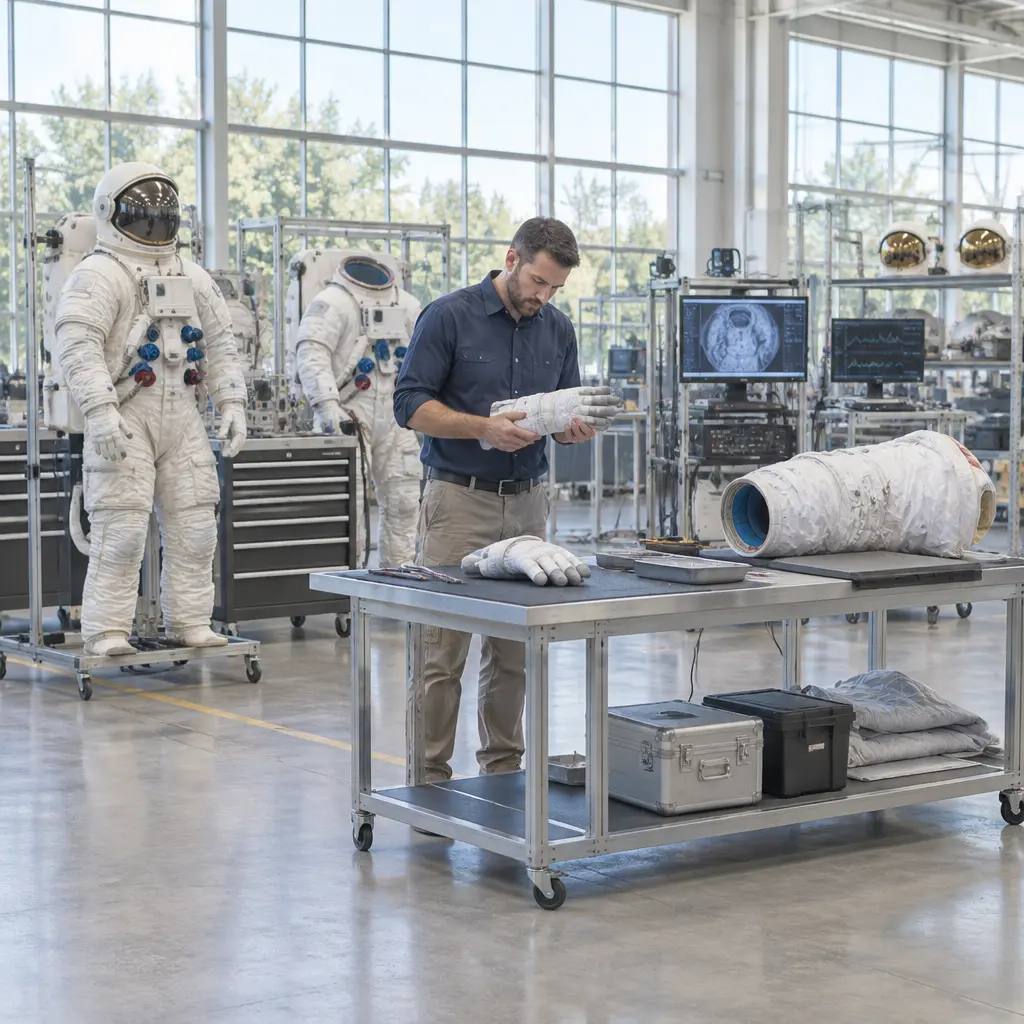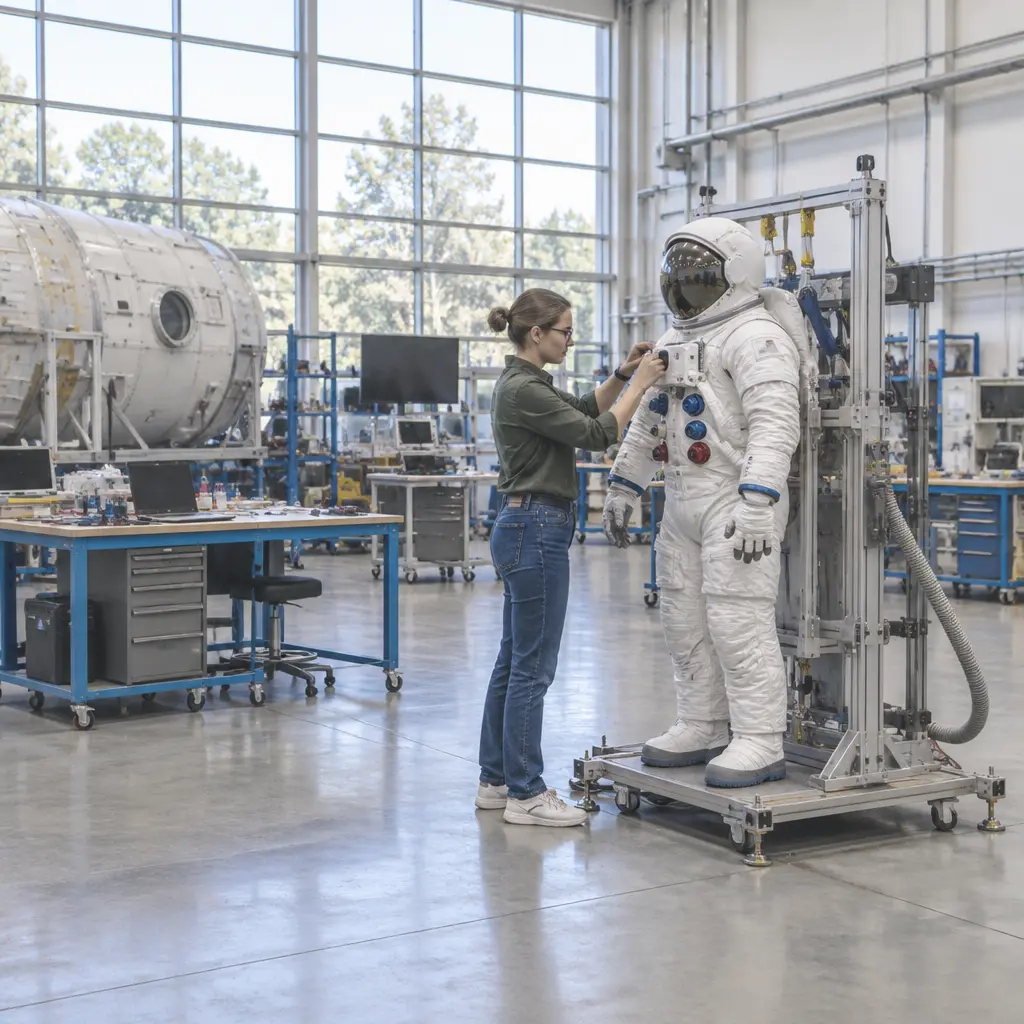
A spacesuit is a wearable life-support system designed to protect an astronaut from the vacuum, temperature extremes, radiation, and other hazards of space. Before a suit is cleared for flight, engineers test its pressure integrity, mobility, cooling, communications, and ability to work with spacecraft and crew procedures. NASA’s Extravehicular Mobility Unit (EMU), for example, is made up of multiple components and is tested through inspections, pressure checks, underwater training, and integrated evaluations—not a single pass-or-fail trial. These tests matter because a leak, a stiff joint, or a failed cooling connection can threaten an astronaut during a spacewalk, which may last for hours.
Testing protects spacesuit performance before flight
Spacesuit testing is the process of verifying that a suit and its supporting equipment meet safety and performance requirements in conditions that approximate launch, spacecraft operations, and spacewalks. NASA describes the EMU as a self-contained system that provides pressure, oxygen, temperature control, communications, and protection from the space environment. Testing therefore covers both the suit as a whole and the interfaces among its parts, the astronaut, and the spacecraft.
The risk is consequential: during an extravehicular activity (EVA), an astronaut depends on the suit for essential life support outside a pressurized spacecraft. NASA’s standard spacewalks can last up to about eight hours, depending on the task and mission plan. That makes endurance, reliable cooling, clear communications, and manageable physical workload as important as simply keeping the suit pressurized.
Pressure integrity is the first spacesuit attribute engineers verify
Pressure integrity means the suit can maintain the pressure needed to protect its wearer without unacceptable leakage or structural failure. NASA’s descriptions of the EMU emphasize that its pressure garment forms a sealed enclosure around the astronaut. Engineers check seals, closures, connectors, and the assembled garment because a fault at any one of these points can compromise the whole system.
Pressure tests are only one part of the verification picture. A suit must maintain pressure while its wearer bends, reaches, grips tools, and changes position. For that reason, leak checks are complemented by tests of joints, restraint layers, gloves, and life-support connections. A static check can find a leak; an integrated evaluation helps reveal whether movement or equipment handling creates a problem.
Leak checks and pressure holds
A pressure-hold test checks whether the assembled suit retains pressure over a specified period. Technicians inspect the suit and its fittings, bring it to a prescribed test condition, and monitor for pressure loss according to the applicable procedure. The exact limits and methods depend on the suit design and test configuration; they are not universal values that can be applied to every model.
These checks are repeated at relevant stages of maintenance and readiness work. They can help detect damage, degraded seals, or a poorly seated connection before a suit is assigned to a crew member. NASA’s public EMU materials explain the system’s pressure-protection role, while detailed acceptance criteria and operational procedures are controlled through program-specific engineering documentation.
Gloves, joints, and suit fit
A pressurized suit resists movement, so mobility testing examines whether the astronaut can perform required tasks while wearing it. Engineers and crew assess shoulder and hip movement, elbow and knee joints, wrist rotation, glove dexterity, and the fit of the suit’s hard and soft components. Fit matters because pressure distribution and joint alignment affect comfort, reach, and the effort needed to operate tools.
NASA’s spacesuit training uses underwater environments to let astronauts practise EVA tasks while wearing a pressurized suit. The Neutral Buoyancy Laboratory (NBL) pool is approximately 40 feet deep and contains a full-size mock-up of the International Space Station. Underwater practice does not reproduce every feature of space, but it allows crews and engineers to evaluate task choreography, reach, visibility, and equipment handling in a controlled setting.
Life-support testing checks cooling, oxygen, and communications
A spacesuit’s life-support system supplies and manages the conditions needed for an astronaut to work. In NASA’s EMU, the portable life support system (PLSS) supports functions including oxygen supply, carbon-dioxide removal, cooling, and communications. Testing must establish that these functions operate together and that alarms or controls give the astronaut and ground team usable information.
This is where component tests connect to integrated system tests. A cooling loop may work on its own, but the suit must also move heat away from the astronaut during physical activity. A radio may pass a bench check, yet communications must remain intelligible through the helmet and suit system while the crew performs tasks. NASA’s EVA procedures and training combine equipment checks with operational practice because performance depends on both hardware and human use.
Thermal control and water-cooling garments
Thermal-control testing evaluates how the suit removes body heat and maintains workable conditions. The EMU uses a liquid cooling and ventilation garment worn beneath the pressure garment; water circulating through small tubes carries heat away from the astronaut. Engineers evaluate flow, connections, temperature regulation, and integration with the PLSS, while crew training helps identify whether controls and procedures are practical.
Thermal performance cannot be judged from a room-temperature inspection alone. Spacewalks involve strenuous work, and the space environment brings large temperature contrasts depending on exposure to sunlight and shadow. Test campaigns therefore use appropriate environmental or operational simulations and assess whether the suit’s cooling system can support the planned activity.
Oxygen, carbon-dioxide removal, and communications
Life-support checks verify that the suit can deliver breathable oxygen, remove exhaled carbon dioxide, and support communication between the astronaut and mission control. The PLSS incorporates equipment for these functions, and tests examine both component operation and the readings or warnings available to the crew. Clear communications are a safety function: astronauts need to exchange instructions, report conditions, and respond to contingencies.
NASA’s suit and EVA training materials describe checklists and communications as part of spacewalk preparation. In practice, technicians and crew verify suit connections and conduct communication checks before an EVA. These operational checks complement laboratory testing; they confirm the assembled equipment is ready for the specific mission configuration.
Environmental and human-factors tests simulate the mission
Environmental testing exposes suit components or assemblies to conditions relevant to their intended use, such as temperature extremes, vibration, or vacuum, where appropriate to the design and qualification plan. Human-factors evaluation asks whether the astronaut can see, move, operate controls, and complete tasks safely while wearing the suit. Together, these approaches test not only whether the equipment survives, but whether it remains usable.
No single simulation reproduces space perfectly. Neutral buoyancy approximates weightlessness for many movement and task-planning purposes, but water creates drag and does not reproduce vacuum, radiation, or the exact thermal environment. Similarly, a thermal-vacuum test can evaluate hardware under controlled environmental conditions but cannot replace crew training. Programs use multiple methods because each reveals different failure modes.
Vacuum and thermal-vacuum evaluation
A vacuum test evaluates equipment in a low-pressure environment, while a thermal-vacuum test also controls temperature to represent selected conditions in space. Depending on the qualification plan, such tests can help assess materials, seals, mechanisms, and system operation. They are especially useful for discovering whether components behave differently when exposed to vacuum or temperature extremes than they do in a laboratory atmosphere.
Test conditions are chosen for the hardware and mission being evaluated, rather than assuming that every spacesuit undergoes an identical sequence. NASA’s public accounts of spacesuit development describe extensive ground testing and qualification, but detailed test procedures can be specific to a program, hardware generation, and certification decision.
Underwater training and task validation
Underwater training validates how a suited astronaut performs planned EVA tasks in a simulated weightless environment. At NASA’s NBL, astronauts practise procedures around a submerged ISS mock-up while support divers and teams monitor the exercise. The facility’s roughly 40-foot-deep pool provides room for large-scale training, including movement between work sites and the use of spacewalk tools.
This is a practical example of testing a complete work system rather than a garment alone. A task may need to be redesigned if an astronaut cannot reach a handrail, operate a tool comfortably, or complete an operation within the planned timeline. The results can inform procedures, equipment placement, training, and suit configuration before the actual mission.
Integrated verification brings suit, spacecraft, and crew together
Integrated verification checks that the suit works with the spacecraft, airlock, tools, crew, and operating procedures as one system. Before an EVA, astronauts and ground teams follow readiness procedures that include suit preparation, communications, life-support checks, and coordination with the spacecraft. Engineers also evaluate interfaces such as umbilicals, connectors, displays, and suit components that must work with a particular vehicle or station.
This final layer matters because a well-tested component can still fail operationally if it is incompatible with another part of the mission. NASA’s ISS spacewalk process uses extensive planning and training, including underwater simulations and step-by-step procedures. The same systems approach is relevant to new suits: qualification must consider the intended wearer, vehicle, mission duration, tools, and emergency responses—not only the suit’s isolated performance.
Conclusion: Ground testing turns a spacesuit into mission-ready equipment
Before a spacesuit leaves Earth, teams verify pressure integrity, mobility, life support, thermal control, communications, environmental performance, and compatibility with the spacecraft and EVA plan. Pressure checks look for leaks; functional tests examine oxygen, cooling, and communications; underwater training validates movement and task procedures; and integrated evaluations confirm that people and equipment work together.
Because a spacewalk may last for hours and depends on a suit as a personal life-support system, layered testing is essential to astronaut safety and mission success. For further reading, consult NASA’s spacesuit and EVA training resources, including information about the Extravehicular Mobility Unit and the Neutral Buoyancy Laboratory, and look for updates on next-generation suit qualification as lunar exploration missions develop.
Sources: NASA, “Spacesuits,” https://www.nasa.gov/humans-in-space/spacesuits/; NASA, “Extravehicular Mobility Unit,” https://www.nasa.gov/reference/extravehicular-mobility-unit/; NASA, “Neutral Buoyancy Laboratory,” https://www.nasa.gov/johnson/nbl/; NASA, “Spacewalks,” https://www.nasa.gov/missions/station/iss-research/spacewalks/; NASA, “What Is a Spacewalk?” https://www.nasa.gov/humans-in-space/spacewalks/