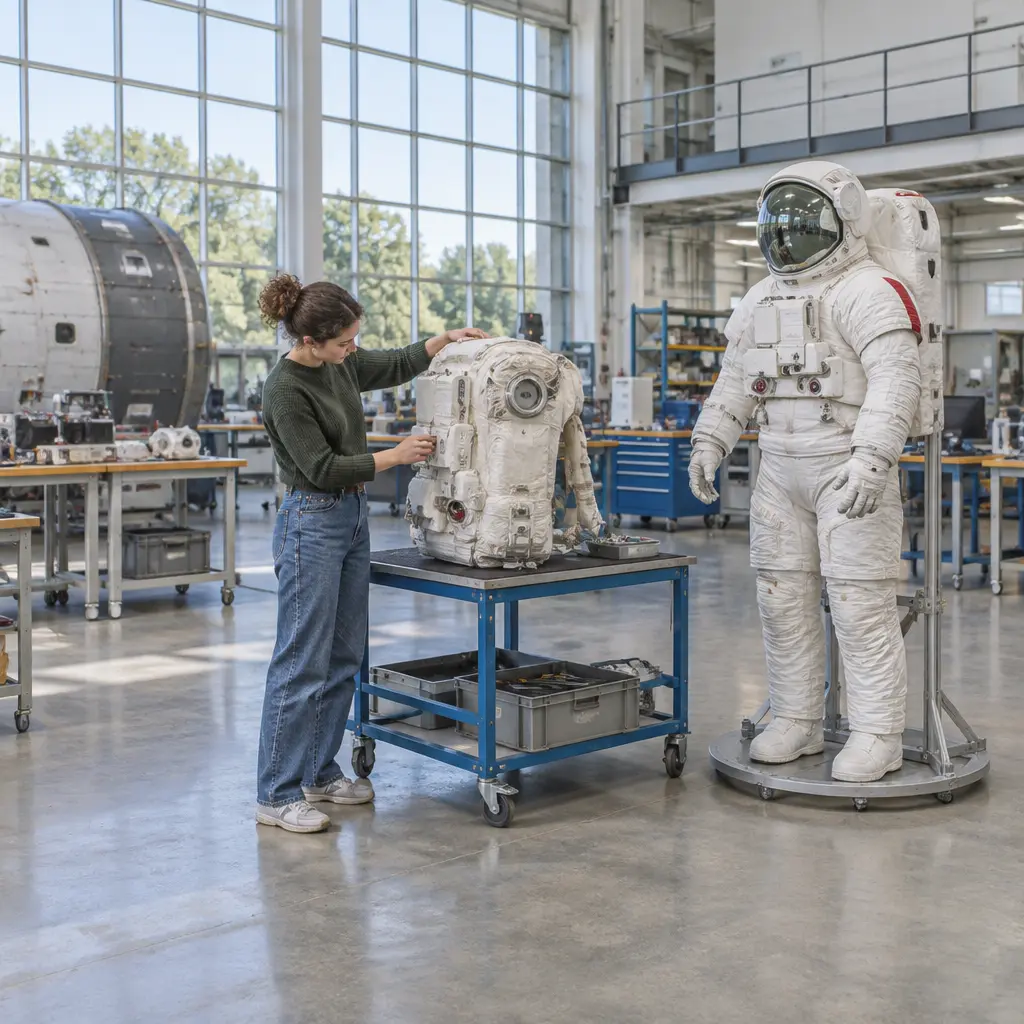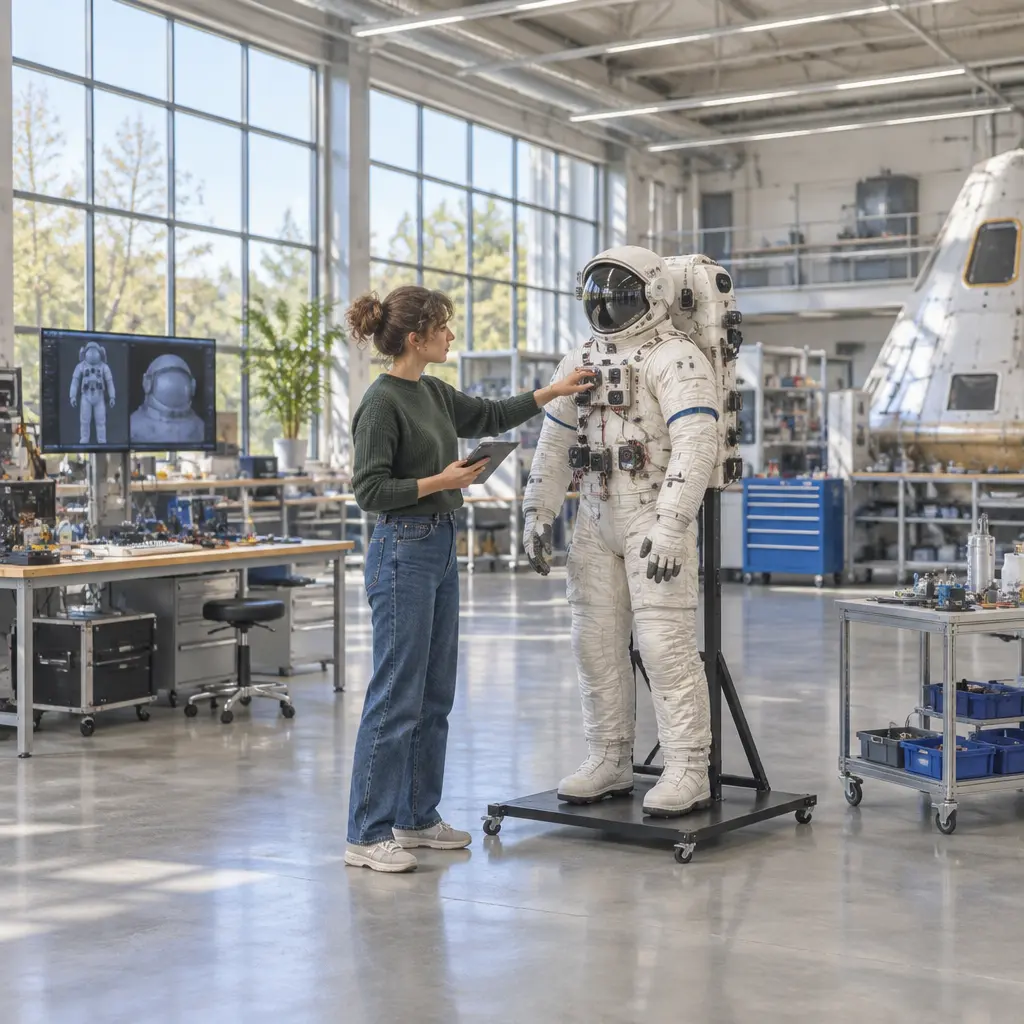
A future spacesuit could function as a wearable health-monitoring system: sensors woven into garments or attached to the body could track vital signs, suit conditions, and movement, then alert an astronaut or mission team when readings suggest a problem. NASA already monitors crew health and suit status during missions, while research into wearable sensors points toward more continuous, less intrusive measurements. This matters because a spacesuit is both a life-support system and a small, demanding work environment: NASA’s current extravehicular mobility unit supports spacewalks lasting up to about 8.5 hours, during which heat, exertion, dehydration, and changing physiology can affect safety. The sections below explain how suit-based monitoring works, which health signals it could measure, how alerts and data might be used, and what technical and privacy challenges remain.
How future spacesuits could monitor astronaut health
Spacesuit health monitoring is the measurement and interpretation of an astronaut’s physiological condition while the person is suited for an activity such as a spacewalk. NASA describes the spacesuit as a personal spacecraft: it supplies pressure, oxygen, temperature control, communications, and protection from the vacuum and other hazards. A health-monitoring layer would add sensors and software to help detect changes in the wearer, rather than relying only on scheduled checks or the astronaut’s own perception.
The concept has several related forms, or hyponyms: physiological monitoring measures bodily signals; environmental monitoring measures conditions inside the suit; activity monitoring interprets movement and workload; and decision-support systems combine those inputs to generate warnings. These categories overlap. For example, a rising heart rate may be more meaningful when considered alongside workload, suit temperature, and the duration of the task.
Physiological monitoring
Physiological monitoring uses sensors to estimate body functions such as heart rate, breathing, skin temperature, and—in some research systems—electrical activity from the heart or muscles. Sensors could be embedded in a close-fitting base layer, attached as patches, or integrated into helmet and wrist interfaces. The goal is to collect useful trends without restricting motion or creating pressure points beneath the suit.
NASA’s Human Research Program identifies cardiovascular changes, altered sleep, radiation exposure, and other health risks as important areas for human spaceflight research. In a suit, continuous heart-rate and breathing data could help identify unusual exertion or a developing problem, but those signals are not diagnoses on their own. Motion, sensor contact, suit pressure, and individual differences can affect readings, so systems need validation in realistic conditions and should be interpreted alongside other evidence.
Suit-environment and workload monitoring
Environmental monitoring measures the conditions surrounding the astronaut, including suit pressure, oxygen supply, carbon-dioxide removal, humidity, and temperature. These measurements already form part of spacecraft and suit engineering; a future health system could make them more tightly connected to physiological data. For example, a change in breathing rate could prompt a check of workload and life-support readings rather than being treated as an isolated number.
Activity monitoring uses movement sensors—such as accelerometers and gyroscopes—to estimate posture, motion, and task intensity. NASA’s current extravehicular mobility unit is designed to support spacewalks of up to approximately 8.5 hours, including preparation and operational constraints that make workload management important. Movement data could help distinguish normal exertion during a demanding task from an unexpected reduction in activity, while also supporting review of how much effort particular suit operations require.
How suit health data could support decisions
Collecting signals is only one part of monitoring. A useful system must determine which changes matter, communicate them clearly, and fit the procedures astronauts already use. The most practical approach is likely layered: immediate feedback for the crew, a summary for mission control, and records that support post-activity medical review.
Alerts and onboard decision support
Decision-support software could compare an astronaut’s measurements with personal baselines, mission limits, and the current task. A warning might recommend a pause, a sensor check, or a communication with the flight team; it should not automatically label a reading as a medical emergency when movement or poor sensor contact could explain it. NASA’s human-spaceflight operations rely on established communication and contingency procedures, so any automated warning would need to complement—not replace—crew judgment and mission rules.
Combining signals can improve context. A heart-rate increase accompanied by higher movement may reflect expected exertion, whereas the same increase with little movement and an abnormal suit temperature could warrant closer attention. Such interpretation is a design objective, not a guarantee: algorithms must be tested against varied bodies, suit configurations, tasks, and sensor failures before they can be trusted in operational use.
Communication, records, and post-activity review
A monitored suit could send selected measurements through the spacecraft communication system to mission control, while keeping essential displays available to the astronaut. NASA already uses communications and telemetry to follow spacecraft and spacewalk operations; adding health data would require careful choices about bandwidth, data reliability, and what information is most urgent. If a link is interrupted, the suit should still provide essential local alerts and preserve data for later transfer.
After an activity, time-stamped data could help medical teams compare the astronaut’s workload and suit conditions with recovery, symptoms, and reported discomfort. This could also support engineering improvements by revealing recurring hot spots, high-effort tasks, or sensor problems. Such records would need clear rules for access, retention, and use, particularly because physiological data is sensitive personal information.
Challenges in building reliable health-monitoring spacesuits
A health sensor that works in a clinic may not work well inside a pressurized suit. Spacewalk systems must tolerate movement, vibration, temperature changes, limited maintenance opportunities, and strict mass and power constraints. Design teams therefore have to balance measurement quality with comfort, durability, and the life-support functions that keep the astronaut alive.
Sensor accuracy, comfort, and validation
Sensors must maintain reliable contact without chafing, restricting circulation, or interfering with donning and doffing. Sweating, motion artifacts, and changes in body position can distort measurements, while a loose or damaged sensor may produce misleading gaps. Validation should therefore compare wearable readings with suitable reference instruments during representative tasks, not just during quiet laboratory tests.
The system must also account for differences among astronauts. A fixed threshold may be inappropriate when normal heart rate, fitness, or recovery patterns vary between individuals. Personalized baselines and transparent uncertainty estimates could help, but they require enough high-quality data and careful safeguards against overconfidence in software outputs.
Power, data security, and human factors
Every additional sensor and processor uses power and can add mass, wiring, and failure points. Suit designers must prioritize measurements with clear safety value and ensure that monitoring equipment cannot compromise oxygen delivery, pressure integrity, thermal control, or communications. Data transmission also needs protection against loss, corruption, and unauthorized access.
Alerts must be understandable under stress and should avoid overwhelming the astronaut with false alarms. The interface should make clear what was measured, how certain the system is, and what action is recommended. NASA’s human-factors approach to crewed missions emphasizes designing equipment around human capabilities and operational demands; health-monitoring displays should follow the same principle.
Conclusion: from spacesuit telemetry to personal health insight
Future spacesuits could connect physiological monitoring, suit-environment measurements, and activity tracking to give astronauts and mission teams a more complete picture of health during demanding work. Carefully designed alerts and post-activity records may help identify concerning trends earlier and improve both medical support and suit design. But sensors alone are not enough: accuracy, comfort, power, cybersecurity, privacy, and human-centered alerts must all be addressed and validated before such systems can be relied upon. Readers can explore NASA’s human research and spacesuit programs to follow how these capabilities develop, and why monitoring must remain part of a broader life-support and medical-safety system.
Sources: NASA, “Spacesuits,” https://www.nasa.gov/humans-in-space/spacesuits/; NASA, “Extravehicular Mobility Unit,” https://www.nasa.gov/reference/extravehicular-mobility-unit/; NASA Human Research Program, “Human Research Roadmap,” https://humanresearchroadmap.nasa.gov/; NASA, “Spacewalks,” https://www.nasa.gov/missions/station/iss-research/spacewalks/; NASA, “Human Factors and Behavioral Performance,” https://www.nasa.gov/hrp/.