
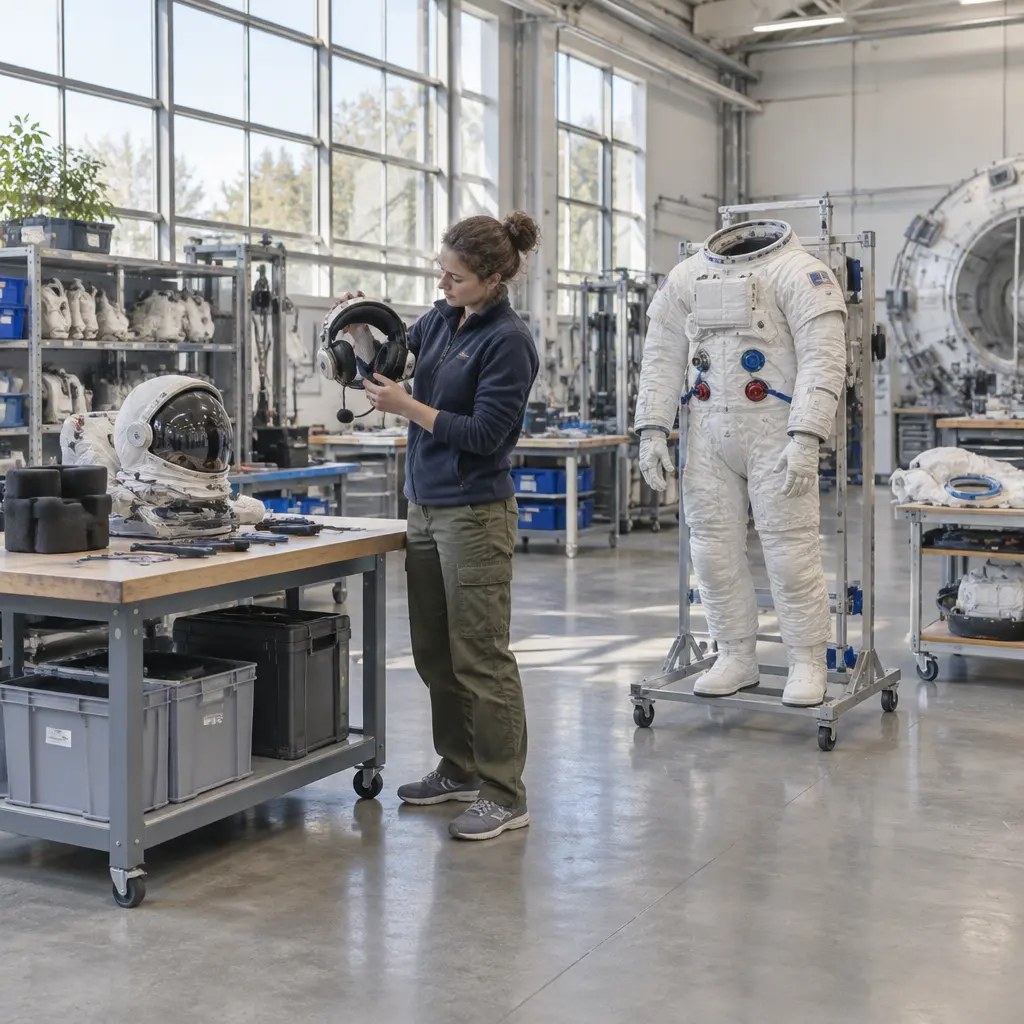
Modern spacesuit communication gear is the equipment that lets astronauts exchange voice, status, and warning information while wearing a pressurized suit. It has become a core part of the spacesuit because spacewalks depend on reliable coordination among crew members and mission control: NASA describes the International Space Station’s U.S. spacesuit as supporting spacewalks that can last up to about eight hours, during which astronauts must hear instructions, report problems, and stay connected despite vacuum, noise, and restricted movement. Communication systems therefore serve not as accessories but as part of the suit’s operational safety architecture—linking microphones and headphones to radios, suit electronics, and mission procedures.
Spacesuit Communication Gear Defines the Crew’s Operational Link
Spacesuit communication gear is the integrated set of audio and radio components that carries speech and selected status information between a suited astronaut, other crew members, and mission control. NASA’s descriptions of the Extravehicular Mobility Unit (EMU) identify a communications carrier assembly—often called the “Snoopy cap”—that holds microphones and earphones inside the helmet, connected to the suit’s communications equipment. In practical terms, the system turns a sealed, isolated pressure garment into a working communications station.
The need is unusually demanding. Sound cannot travel through the vacuum outside a spacecraft, so astronauts cannot speak to one another directly across open space. At the same time, suit fans, pumps, breathing equipment, and radio circuitry create a noisy environment inside the helmet. A communication failure can impede coordination or delay recognition of a developing problem. NASA’s spacewalk guidance notes that astronauts are supported by a spacewalk partner and ground teams, making intelligible, continuous communication central to completing tasks and responding to contingencies.
Voice links connect astronauts and mission control
The primary function is two-way voice: astronauts hear instructions and talk through their actions, while mission controllers monitor progress and provide guidance. This link supports routine work such as tool use and procedure checks as well as time-sensitive coordination. NASA’s Apollo records, for example, document continuous voice exchanges between lunar crews and Mission Control during surface operations; modern spacewalks retain the same essential relationship, even as digital systems and suit designs evolve.
Communication is part of a wider life-support system
Communication equipment works alongside the suit’s pressure, oxygen, cooling, and warning systems. It does not replace those life-support functions, but it helps astronauts and ground teams interpret conditions and coordinate a response. NASA’s EMU documentation describes the suit as a self-contained system for extravehicular activity, with communications integrated into the broader assembly. That integration matters because a message about a task, a suit indication, or an unexpected symptom must reach the people able to act on it.
Spacesuit Communication Gear Improves Safety and Task Coordination
The safety value of communication lies in both prevention and response. Before and during a spacewalk, astronauts use voice checklists to confirm readiness, coordinate movement, and verify task steps. If a problem arises, clear communication helps the crew report symptoms or equipment behavior and helps mission control decide whether to continue, pause, or end the activity. NASA’s spacewalk procedures include continuous coordination with the ground, while its descriptions of the EMU emphasize the suit’s role in supporting crew operations in the vacuum of space.
Closed-loop communication reduces ambiguity
Closed-loop communication is a method in which a recipient repeats or confirms an instruction so the sender can verify it was understood. In a spacesuit, this practice is especially useful because helmet audio, breathing sounds, equipment noise, and radio interruptions can obscure words. Repeating a tool request, procedure step, or status report helps catch misunderstandings before they affect the work. The principle is familiar in aviation and medicine, but in spaceflight it is reinforced by checklists, assigned roles, and mission-control protocols.
Audio quality supports situational awareness
Situational awareness means understanding what is happening, what it may mean, and what is likely to happen next. Clear audio helps astronauts maintain that understanding by conveying task updates, warnings, and changes in plan. NASA has reported that spacewalks can approach eight hours, depending on the activity and mission plan; over that duration, comfort, intelligibility, and dependable connections are operational concerns rather than minor conveniences. Communication also allows teams to coordinate when an astronaut’s view is limited by the helmet, worksite geometry, or body position.
Radio discipline helps crews manage workload
Radio discipline is the use of concise, structured messages so that important information remains understandable and the channel stays available. Spacewalk teams must balance talk with hands-on tasks, checklist steps, and monitoring suit conditions. Standard terminology and orderly turn-taking reduce unnecessary exchanges and make urgent calls easier to recognize. This practice connects communication hardware to human factors: the equipment enables speech, while procedures make that speech useful under demanding conditions.
Spacesuit Communication Gear Combines Audio, Radio, and Controls
A spacesuit communication system is not just a microphone. It combines the astronaut’s audio interface with suit electronics, radio transmission, power, and controls. NASA’s EMU materials describe the helmet-mounted communications carrier as part of the suit arrangement, while spacecraft systems provide the broader radio path to other crew and ground teams. The exact architecture varies by suit and mission, but the functional categories remain consistent: capture speech, deliver incoming audio, transmit it, and allow the crew to manage the connection.
The communications carrier assembly captures and delivers speech
The communications carrier assembly is the headset worn inside the helmet. It typically positions microphones near the astronaut’s mouth and earphones near the ears, helping preserve a usable audio path within the pressurized suit. NASA’s public descriptions of the EMU use the nickname “Snoopy cap” for this assembly. Its placement must work with the helmet and suit, while remaining stable and comfortable enough for extended operations.
Radio systems carry signals beyond the helmet
The radio link transmits voice from the suit to a spacecraft or communications network and brings incoming audio back to the astronaut. Spacecraft relay systems can then connect crew communications to mission control. The International Space Station’s communications infrastructure supports voice and data exchange with ground facilities, illustrating how suit audio is one endpoint in a larger network rather than a stand-alone device. Signal routing and backup arrangements depend on the mission’s architecture.
Controls and alerts help astronauts manage the connection
Controls let the crew select or manage audio paths, while tones and alerts can draw attention to a change in system state. These functions matter because astronauts may not be able to use ordinary handheld devices while wearing pressurized gloves and carrying out work. Suit interfaces are therefore designed around limited dexterity, visibility, and attention. Communication equipment must be usable as part of the complete suit, not merely perform well in a laboratory test.
Spacesuit Communication Gear Is Evolving for New Missions
Modern suit development is extending communication requirements beyond the International Space Station. NASA’s Exploration Extravehicular Mobility Unit (xEMU) development and commercial lunar-suit work reflect the need to support exploration in environments with different terrain, mission durations, and operating patterns. Communication systems for future suits must preserve dependable voice while accommodating new hardware, operational procedures, and potential digital information services.
Lunar exploration raises demands for adaptable communication
Lunar surface missions require crews to coordinate across changing terrain and work locations, with communication paths shaped by the mission’s radio and relay design. NASA’s Artemis plans include crewed lunar surface exploration, making reliable suit-to-suit and suit-to-ground communication a continuing design requirement. Future systems may need to support more flexible work plans and richer data exchange, while still prioritizing clear voice and robust operation.
Digital integration can add information but raises design trade-offs
Digital suit systems could connect voice with status data, procedural prompts, or other mission information. Such integration may help teams share context, but it also introduces questions about power consumption, reliability, interface complexity, and attention management. The central engineering test is not whether a suit can display or transmit more information; it is whether the added capability improves decisions without distracting the astronaut or compromising essential communication.
Human-centered design remains essential
A communications system must fit the person as well as the mission. Microphone position, audio levels, helmet compatibility, comfort, and ease of use influence whether astronauts can communicate effectively over long operations. This makes crew feedback and testing important parts of development. As NASA and commercial partners design suits for lunar and other exploration missions, the communication interface must remain dependable across different users, tasks, and environments.
Conclusion: Spacesuit Communication Gear Is Mission-Critical
Spacesuit communication gear has become a core part of modern spacesuits because it connects astronauts to one another and to mission control in an environment where unaided speech is impossible. The communications carrier, radio links, controls, and operating procedures work together to support safety, coordination, and situational awareness. Long spacewalks, including activities that can last up to about eight hours, make reliable and usable audio a practical necessity. As lunar exploration advances, suit designers should preserve clear voice communication while carefully evaluating any added digital features. Readers interested in the subject can explore NASA’s EMU and spacewalk materials to learn how communications fit into the wider life-support and mission systems.
Sources: NASA, International Space Station Extravehicular Mobility Unit (EMU), https://www.nasa.gov/reference/international-space-station-extravehicular-mobility-unit/; NASA, Spacewalks, https://www.nasa.gov/missions/station/iss-research/spacewalks/; NASA, Spacesuit Systems, https://www.nasa.gov/humans-in-space/spacesuits/; NASA, Artemis, https://www.nasa.gov/humans-in-space/artemis/; NASA, International Space Station Communications and Tracking, https://www.nasa.gov/mission_pages/station/structure/elements/communications_and_tracking.html.


