
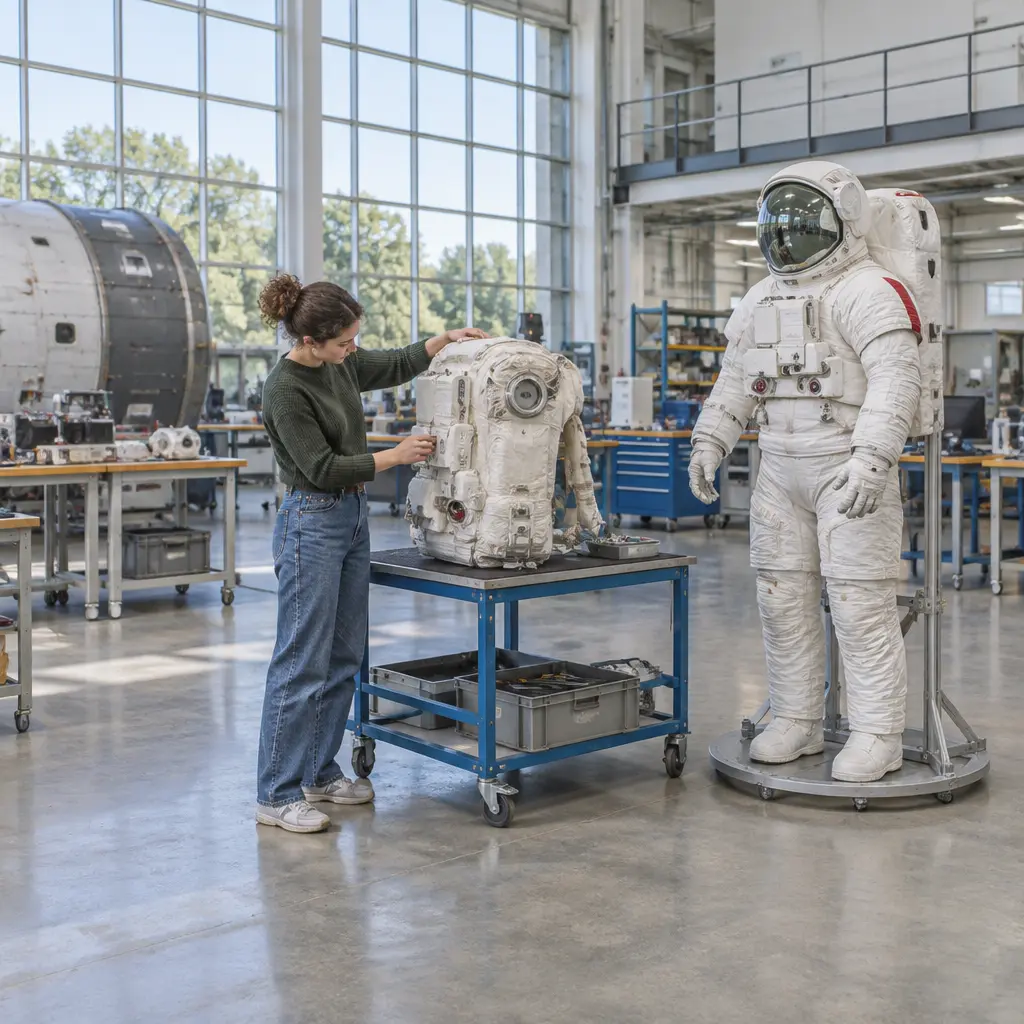
A space suit is a wearable life-support system that protects a person from the vacuum, temperature extremes, radiation, and other hazards of space. Its evolution—from pressure garments developed for high-altitude aviation to the portable spacecraft and lunar suits of today—has expanded what astronauts can safely do outside a vehicle. NASA’s Apollo suits supported moonwalks lasting up to several hours, while the agency’s newer exploration suit is designed for lunar surface work and improved mobility. The story of space suit technology is also a story of changing missions: surviving launch and orbit, working in microgravity, and preparing for longer exploration beyond Earth.
Space suit technology evolved from pressure protection to mobile life support
Space suit technology is the collection of garments, structural layers, and life-support equipment that maintains a habitable environment around a wearer. NASA describes an extravehicular mobility unit, or EMU, as a personal spacecraft: it supplies oxygen, removes carbon dioxide, manages heat and pressure, and helps protect the astronaut from the space environment. The term “space suit” therefore covers several related types, including pressure suits worn during launch and re-entry, suits used for spacewalks, and suits designed for planetary surfaces.
The need is measurable. The International Space Station operates in low Earth orbit, where astronauts cannot survive unprotected in the vacuum. A suit must maintain pressure while allowing movement, regulate heat in environments that can shift rapidly between sunlight and shadow, and support breathing and communications. NASA’s historical accounts show how each generation addressed these demands differently: early suits adapted aviation technology, Apollo suits enabled lunar exploration, and modern designs emphasize maintainability, fit, and broader mobility.
From high-altitude pressure garments to the first space suits
Pressure garments were developed to protect pilots at high altitudes, where falling air pressure makes breathing difficult and can cause bodily harm. These garments provided a foundation for the first crewed spacecraft suits. NASA’s Mercury suits, adapted from U.S. Navy high-altitude flight clothing, were designed primarily for cabin emergencies rather than routine work outside the spacecraft. The distinction shaped later designs: a suit for survival inside a vehicle does not need the same mobility, thermal control, or independent life support as one intended for a spacewalk.
The Mercury program’s suits were pressurized during flight, but astronauts generally relied on the spacecraft’s systems for their environment. NASA’s Gemini program introduced more demanding tasks, including extravehicular activity. Spacewalks exposed shortcomings in mobility and heat management: movement could be tiring, and a pressurized suit resisted bending. These experiences made joint design, cooling, and workload central engineering issues rather than secondary details.
Apollo suits made lunar surface work possible
The Apollo lunar suit, officially the A7L, combined a pressure garment with a portable life-support system and protective outer layers. NASA’s Apollo documentation describes the Portable Life Support System as supplying oxygen, removing carbon dioxide and moisture, circulating cooling water, and supporting communications. The suit also used a liquid-cooling garment worn beneath the pressure layers, helping astronauts shed heat during strenuous work.
The Apollo 11 moonwalk lasted about 2 hours and 31 minutes, according to NASA’s mission record. Later Apollo surface excursions were longer, with astronauts working across multiple moonwalks and using a lunar rover on Apollo 15, 16, and 17. The suits had to accommodate kneeling, walking, collecting samples, and handling tools while protecting against abrasive lunar dust and extreme environmental conditions. Apollo demonstrated that a suit could function as a mobile work platform, not merely emergency clothing.
Space suit design balances pressure, mobility, and environmental protection
A modern space suit is a system of interconnected components rather than a single garment. NASA’s descriptions of the EMU identify a pressure-retaining assembly, thermal and micrometeoroid protection, a life-support backpack, communications equipment, and interfaces such as gloves and the helmet. Each component must work with the others: stronger pressure restraint can make movement harder, while added shielding can increase mass and complicate maintenance.
This engineering trade-off links the suit’s structure to its operating environment. An orbital suit is designed for work near a spacecraft, whereas a lunar suit must support walking and surface tasks in reduced gravity and abrasive dust. Both depend on pressure and life support, but their missions give different weight to mobility, dust resistance, portability, and serviceability.
Pressure garments and joints preserve a usable shape
A pressure garment maintains an internal pressure that allows the astronaut to breathe and prevents the body from being exposed directly to vacuum. The suit must also keep its shape without becoming too rigid to use. Designers use shaped joints, restraint layers, and specialized bearings to reduce the effort needed to bend arms and legs. NASA’s EMU documentation describes the suit as operating at approximately 4.3 pounds per square inch, a pressure lower than sea-level atmospheric pressure but suitable for its oxygen-based operating environment.
The suit’s gloves illustrate the difficulty of combining protection with dexterity. They must retain pressure and provide thermal protection while allowing astronauts to grip tools and operate connectors. Hand fatigue and fit are practical concerns because work outside a spacecraft can require repeated gripping, fastening, and manipulation. These design requirements explain why suit sizing and custom fitting are operational issues as well as comfort considerations.
Thermal control and life support keep the wearer stable
Thermal control removes body heat produced by exertion and helps manage heat gained from sunlight or lost to cold surroundings. In the EMU, a liquid-cooling and ventilation garment circulates water through small tubes near the body. NASA identifies this garment as a key part of the suit’s temperature-control system. The liquid loop works with ventilation and the backpack’s heat-rejection equipment to maintain conditions suitable for work.
The life-support system also supplies oxygen, removes exhaled carbon dioxide, and supports pressure regulation and communications. NASA’s EMU fact sheets describe the backpack as containing oxygen supplies, carbon-dioxide removal equipment, batteries, cooling hardware, and a radio. The system’s operating duration depends on mission configuration and consumables; it is not an unlimited environment. Suit checks, backup procedures, and mission planning therefore remain essential parts of spacewalk safety.
Outer layers guard against radiation, impacts, and dust
The suit’s outer layers help protect against thermal extremes, small high-speed particles, and abrasion. In orbit, micrometeoroids and orbital debris pose impact hazards, while lunar exploration adds fine dust that can cling to materials and wear surfaces. NASA’s Apollo records document concern about lunar dust because it was abrasive and could interfere with equipment and suit components. Dust management is consequently a design and operational challenge for future surface missions, not simply a matter of keeping the suit clean.
Space suits do not provide complete protection from all radiation. They can reduce exposure to some particles, but shielding is limited by the need to keep the suit wearable. NASA and other space agencies therefore treat radiation protection as a broader mission-design problem involving spacecraft shelter, forecast awareness, and limits on exposure as well as suit materials.
Space suit types reflect the work astronauts perform
The predicate “space suit” includes several hyponyms—specific suit types distinguished by where and how they are used. Launch-and-entry suits protect crew members during dynamic phases of flight, while intravehicular suits are intended for use inside a spacecraft. Extravehicular mobility suits support work outside a vehicle, and planetary surface suits are designed for walking, sampling, and operating equipment on another world. Grouping suits by task clarifies why one design cannot automatically serve every mission.
Launch-and-entry suits protect crews during flight emergencies
A launch-and-entry suit is worn during spacecraft ascent and return, when cabin pressure loss or other emergencies could threaten the crew. NASA’s Space Shuttle orange Advanced Crew Escape Suit, commonly called the “pumpkin suit,” was designed for protection during launch and landing rather than prolonged work in vacuum. The suit’s role contrasts with an EVA suit: it supports crew survival in a vehicle-related emergency but is not a self-contained system for routine spacewalking.
Extravehicular suits support spacewalks in orbit
An extravehicular mobility suit is a self-contained or vehicle-supported suit used outside a spacecraft. NASA’s EMU has been used for spacewalks from the Space Shuttle and the International Space Station. It includes a hard upper torso, lower-body assembly, helmet, gloves, and portable life-support backpack. Astronauts use these suits for tasks such as installing equipment, inspecting spacecraft, and maintaining station systems.
Spacewalks also depend on equipment beyond the suit itself. Tethers, handrails, tools, airlocks, and crew procedures help prevent separation from the spacecraft and make work possible. NASA’s spacewalk guidance emphasizes training and preparation because suit mobility is constrained and tasks must be carefully sequenced. Thus, the effective “system” for an EVA includes both the garment and the spacecraft infrastructure around it.
Planetary surface suits prioritize walking and fieldwork
A planetary surface suit is designed for movement and work on a planetary body, where astronauts may walk over uneven terrain, carry tools, and collect samples. Apollo’s A7L suits established this category for the Moon. NASA’s Artemis-era Exploration Extravehicular Mobility Unit, or xEMU, was developed as a next-generation design intended to support lunar surface operations and a wider range of astronaut body sizes. NASA has described design goals that include improved mobility and maintainability compared with legacy suits.
The suits being developed for Artemis must address conditions different from those of Apollo, including longer-term exploration plans and the challenging environment of the lunar south pole. NASA’s program materials describe the need for mobility, dust tolerance, and reliable life support, while the agency’s spacesuit development work has involved commercial partners. These are development goals and program plans; operational performance will ultimately be demonstrated through testing and missions.
Space suit development continues toward Artemis and commercial operations
The current generation of suit development responds to aging hardware, changing mission profiles, and the need for better fit and supportability. NASA’s long-used EMU entered service in the Space Shuttle era and has supported decades of station operations, but maintaining legacy systems presents challenges when components and manufacturing expertise become harder to sustain. New designs aim to make suits more adaptable to different tasks and crew members while preserving the safety functions established by earlier generations.
Artemis suits target lunar exploration needs
NASA’s Artemis surface suit effort is intended to support crew operations on the Moon, including walking, collecting samples, and using tools. In 2022, NASA selected Axiom Space to develop the next-generation lunar suit under a services contract. NASA’s announcement described the work as part of preparing for Artemis missions and emphasized that the suit would be tested before lunar use. The selection illustrates a shift toward government-commercial partnerships in suit development, although NASA remains responsible for mission requirements and astronaut safety.
The lunar environment makes fit and mobility especially important. A crew member must be able to crouch, reach, and move over uneven ground while wearing a pressurized system and carrying life-support equipment. Dust can affect seals, joints, and external surfaces. These requirements connect suit design to mission architecture: tools, vehicles, airlocks, and surface procedures all influence what the suit must do.
Commercial and operational lessons shape the next generation
Commercial involvement is changing how agencies procure and develop space hardware. NASA’s 2022 award to Axiom Space established a contract pathway for development and services rather than relying solely on an agency-built suit. Such arrangements may broaden the supplier base, but they also require careful coordination of technical standards, testing, and integration with NASA spacecraft and mission operations.
The history of suit development cautions against treating a prototype as a flight-ready system. A suit must be tested for pressure integrity, joint performance, thermal management, communications, emergency procedures, and compatibility with the vehicle and mission. The Apollo experience, the long operational life of the EMU, and ongoing Artemis development all show that improvements must be validated as a complete system, not just as new materials or a more flexible joint.
Conclusion: Space suit technology expands human capability
Space suit technology has evolved from high-altitude pressure garments into complex personal life-support systems. Apollo suits enabled hours of lunar exploration; orbital suits support maintenance and research outside spacecraft; and Artemis-era development is aimed at the demands of renewed lunar surface work. Across these generations, the central design challenge remains the same: preserve life while allowing people to move, think, and work in an environment that would otherwise be unsurvivable.
Pressure garments, thermal control, life support, protective layers, and mission-specific suit types are all parts of that evolution. As space agencies and commercial partners develop new systems, readers can follow NASA’s Artemis and spacesuit updates and review historical Apollo and Shuttle records to understand how engineering lessons become operational capability. The next generation of suits will help determine how safely and productively humans can explore the Moon and, eventually, more distant destinations.
Sources: NASA, “Spacesuit”; https://www.nasa.gov/humans-in-space/spacesuits/; NASA, “The Apollo 11 Moonwalk”; https://www.nasa.gov/history/alsj/a11/a11eva.html; NASA, “Apollo 11 Mission Overview”; https://www.nasa.gov/mission/apollo-11/; NASA, “Extravehicular Mobility Unit (EMU)”; https://www.nasa.gov/reference/extravehicular-mobility-unit-emu/; NASA, “NASA Selects Axiom Space to Develop Next-Generation Spacesuits”; https://www.nasa.gov/news-release/nasa-selects-axiom-space-to-develop-next-generation-spacesuits/; NASA, “Spacesuits and Spacewalks”; https://www.nasa.gov/humans-in-space/spacesuits-and-spacewalks/.


