
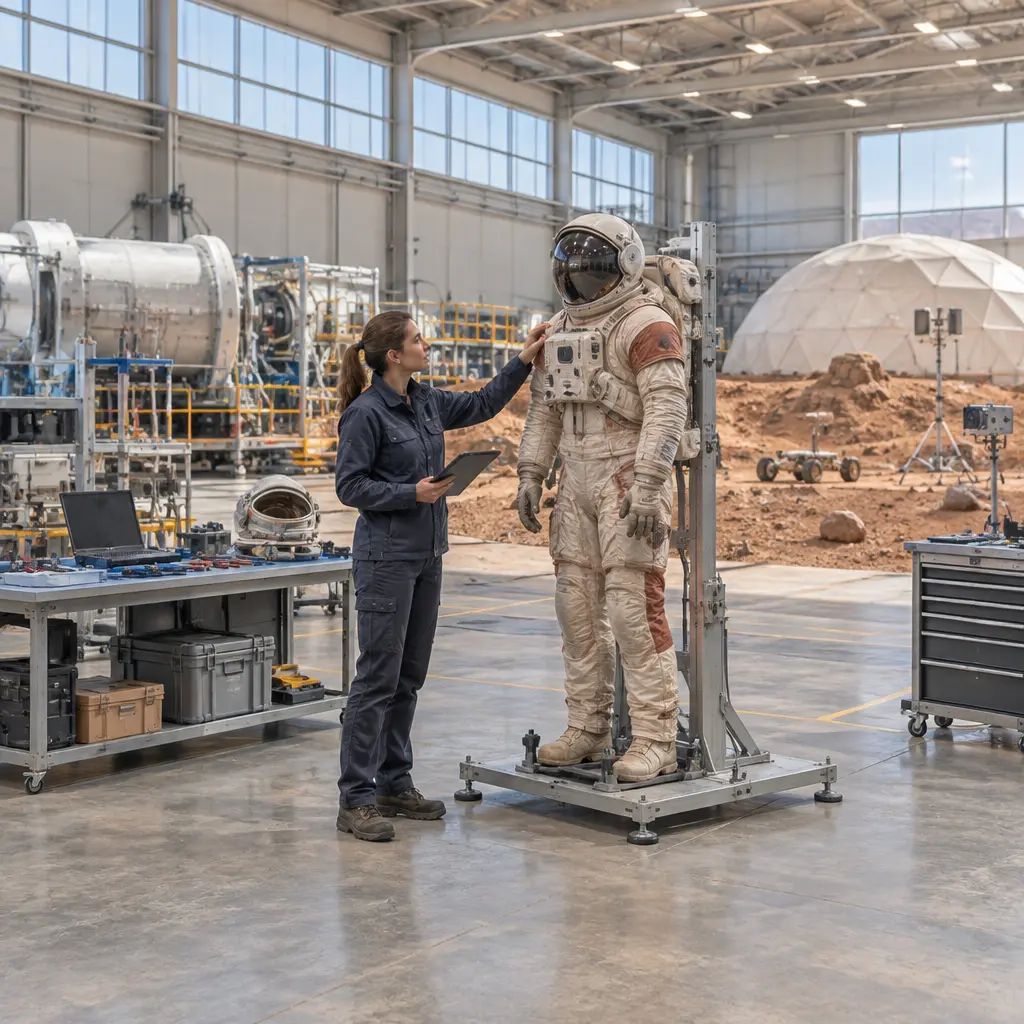
A Mars spacesuit is a pressurized, life-supporting garment designed to keep an astronaut alive and mobile in an environment with near-vacuum pressure, extreme temperatures, radiation, and abrasive dust. For long-duration Mars missions, suit design must limit dust entry and transfer while remaining safe, repairable, and comfortable through repeated work and wear. NASA’s spacesuit research, Apollo-era contamination lessons, and Mars surface-environment data point to a layered strategy: keep dust out at seals and interfaces, reduce dust adhesion and abrasion, isolate dirty suit surfaces from habitats and vehicles, and test performance over realistic cycles. These measures matter because Martian dust is pervasive, fine-grained, electrostatically active, and potentially harmful to equipment and crew; meanwhile, NASA’s reference mission planning has considered surface stays of roughly 500 days, making durability and maintainability as important as short-term protection.
Control dust exposure through Mars suit contamination management
Dust mitigation is the set of engineering and operational measures that reduce the amount of particulate matter entering a spacesuit, adhering to its exterior, abrading its components, or being carried into a habitat. NASA’s lunar and planetary-protection work treats dust as both a materials problem and an interface problem: particles can foul joints, seals, connectors, optics, and airlocks even when they do not penetrate the pressure garment. On Mars, the concern extends from suit surfaces to the crew’s repeated movement between the exterior, rover, and living quarters.
The risk is supported by Mars observations. NASA’s Mars Climate Sounder and other instruments have documented planet-wide dust events, while orbiters and landers show that fine dust can remain suspended and settle on exposed surfaces. NASA’s Mars exploration materials describe typical dust grains as smaller than a human hair; the exact size distribution varies by location and event. The hazard is not simply “dust in the air”: deposited material can be electrostatically charged, mechanically abrasive, chemically reactive, and difficult to remove without spreading it.
The main categories of suit dust mitigation are particulate exclusion at pressure seals, resistant outer materials, reduced-adhesion surfaces, joint and connector protection, and dirty-to-clean transfer procedures. Their effectiveness depends on long-duration wear: a suit that works on the first excursion may fail after repeated flexing, cleaning, thermal cycling, and exposure.
Dust exclusion at seals and interfaces
Dust exclusion means preventing particles from reaching vulnerable spaces, especially pressure seals, bearings, fabric interfaces, electrical contacts, and life-support connections. A suit’s pressure bladder provides the primary life-support boundary, but outer layers and protective covers must prevent abrasive particles from damaging that boundary. Seals around gloves, helmets, boots, and suit entry points deserve particular attention because they are repeatedly handled, flexed, and connected or disconnected.
NASA’s Apollo experience provides a useful warning. Apollo astronauts reported that lunar dust clung to suit surfaces and entered the lunar module; post-mission accounts described irritation and equipment contamination. The Moon is not Mars, but the lesson is directly relevant: containment must be designed around the complete suit-and-habitat system, not only the pressure garment. Dust covers, labyrinth-style barriers, replaceable seal guards, and protected connectors can reduce exposure, but they must not obstruct emergency donning or maintenance.
Abrasion-resistant layers and joint protection
Abrasion resistance is the ability of a suit’s outer layers to withstand scratching, rubbing, and particle-driven wear without exposing or weakening underlying pressure-retaining components. Mars suits need flexible joints for walking, kneeling, tool use, and climbing, but those moving regions are also natural sites for dust accumulation and wear. Protective overlays should therefore be durable without becoming so stiff that they substantially increase crew effort or restrict movement.
The design challenge is measurable. NASA’s spacesuit mobility research evaluates joint torque, range of motion, and task performance, while materials testing can measure abrasion, puncture resistance, and strength after repeated flexing. Designers should compare new materials with aged samples after simulated dust exposure and thermal cycling, rather than relying on a single clean-material test. The resulting data can reveal whether a coating sheds dust but cracks at a knee, or whether a tough fabric creates excessive resistance at the shoulder.
Dust adhesion, electrostatics, and cleaning
Dust adhesion is the tendency of particles to remain attached to a surface through electrostatic attraction, mechanical interlocking, or surface chemistry. Mars’s thin atmosphere and dry conditions make conventional washing impractical, and cleaning methods must not spread particles into crew breathing zones or damage the suit. Candidate approaches include smooth low-adhesion finishes, removable outer covers, controlled brushing or vacuum capture, and electrostatic dust-removal technologies.
NASA’s Electrodynamic Dust Shield research has demonstrated that traveling electric fields can move dust from surfaces in laboratory and space-technology tests. Such systems may be useful on selected suit components or equipment, but a full wearable application must address power use, flexibility, electrical safety, durability, and performance after repeated exposure. The practical goal is not to make a suit perfectly dust-free; it is to remove enough dust at controlled locations to protect seals and prevent unacceptable contamination of the habitat.
Extend Mars suit service life through long-duration wear design
Long-duration wear design is the engineering of a suit for repeated use over months or years, including its pressure garment, mobility system, life-support hardware, hygiene provisions, and maintenance plan. NASA’s human-exploration architectures have studied Mars missions with surface stays on the order of 500 days, although mission profiles remain subject to change. A suit for that setting must support repeated excursions, repairs, cleaning, fit adjustments, and component replacement rather than being treated as disposable equipment.
The distinction between a short demonstration and a mission-ready system is substantial. NASA’s Extravehicular Mobility Unit is designed for orbital work, and its operating history has helped identify the importance of maintenance, fit, thermal control, and life-support reliability. Mars surface suits add abrasive dust, partial gravity, longer periods away from immediate resupply, and a need to move between multiple work sites. These conditions make durability, fault tolerance, and serviceability core safety features.
Mobility, fit, and fatigue management
Mobility is the ability to perform required tasks while wearing a pressurized garment that resists bending and twisting. A well-fitted suit reduces pressure points and unnecessary effort, supporting walking, sample collection, tool operation, and emergency response. Fit must accommodate the crew’s range of body sizes while allowing adjustment for undergarments, gloves, and mission-specific equipment.
NASA’s spacesuit evaluations use tasks such as reaching, grasping, walking, and handling tools to assess human performance. On Mars, a longer surface campaign could involve repeated work shifts and substantial transit on foot or in a pressurized rover. Designers should therefore assess not only maximum range of motion but also fatigue over time, glove dexterity, visibility, balance, and the effort required to recover from a fall. A dust-resistant surface that makes a joint harder to bend can trade contamination control for crew fatigue, so both outcomes must be tested together.
Life support, hygiene, and thermal comfort
A wearable life-support system supplies oxygen, removes carbon dioxide and moisture, manages heat, and supports communication and monitoring. Long-duration wear increases the importance of reliable thermal control, comfortable interfaces, and hygiene arrangements because crew members may spend hours suited up and repeat the cycle frequently. Heat rejection is especially important during strenuous activity, while moisture management helps limit discomfort and skin problems.
NASA’s spacesuit life-support work includes portable systems for oxygen delivery, carbon-dioxide removal, ventilation, and cooling. For Mars, these functions must remain compatible with dust control: filters and cooling passages need protection from contamination, and suit servicing should not release accumulated particles into the cabin. Reusable components should be designed for inspection and replacement with minimal exposure, while consumables and cleaning supplies must be included in mission logistics calculations.
Maintainability, repair, and spares
Maintainability is the capacity to inspect, service, repair, and return equipment to operation with available people, tools, and spare parts. A Mars suit should use modular components where feasible, clearly identify wear limits, and permit replacement of high-wear items such as gloves, seals, outer covers, and joint protections. A modular design can shorten repair time, but each interface adds potential failure points and must itself be protected from dust.
Mission planners should link suit reliability data to the number of planned excursions, crew size, expected wear, and resupply constraints. NASA reliability engineering commonly uses failure-mode analysis and life testing to identify how a component can fail and what the consequences would be. For Mars, testing should track not just whether a part breaks, but how its performance changes after repeated donning, doffing, cleaning, pressure cycles, dust exposure, and storage. That evidence can guide the quantity of spares and the threshold for retiring a component.
Integrate Mars suit dust control with habitat and mission logistics
A Mars suit is one part of a contamination-control chain that includes the airlock, rover, habitat, tool storage, waste handling, and crew procedures. If dust is removed only after a crew member enters the living area, the suit may already have carried particles onto floors, seats, filters, and equipment. System-level planning therefore places the boundary between “dirty” and “clean” zones before the habitat interior and provides a repeatable process for every excursion.
Airlocks, suitports, and clean-zone boundaries
A suitport is an architecture in which a suit attaches to the exterior of a vehicle or habitat so an astronaut can enter or exit without bringing the suit’s dusty exterior inside. NASA has studied suitport concepts as a way to reduce habitat contamination and shorten the time required for airlock operations. This approach can reduce dust transfer, but it requires robust sealing, dependable alignment, and a safe method for servicing a suit from outside the pressurized volume.
Traditional airlocks remain another option, especially when paired with dedicated dust-capture tools and separate storage for contaminated equipment. The mission-level comparison should account for pressure losses, operational time, crew workload, suit inspection, and failure recovery. A useful process diagram would show the sequence from exterior work to suit inspection, dust removal, airlock or suitport transition, and clean-side maintenance.
Operational procedures and crew training
Operational procedures are the repeatable actions that limit contamination and preserve suit condition during use. They include pre-excursion inspections, careful handling of gloves and connectors, controlled brushing or capture of dust, post-excursion checks, and recording of wear or anomalies. Procedures should be simple enough to perform while tired and should specify what to do if a seal, filter, or dust-removal device does not perform as expected.
Training should use realistic mockups and simulated dust, including scenarios involving damaged outer layers, stuck connectors, and reduced visibility. NASA’s analog missions and spacesuit field tests have shown the value of evaluating hardware with crews performing representative geology and maintenance tasks. These exercises can expose human-factors problems that component testing misses, such as a cleaning step that is difficult to complete while wearing gloves or a storage location that encourages contamination of clean tools.
Testing and validation for Mars conditions
Validation is the process of demonstrating that a suit performs its required tasks safely under representative mission conditions. Mars suit tests should combine dust exposure with pressure cycling, thermal extremes, ultraviolet radiation, flexing, impact, and repeated cleaning. A single test in a clean laboratory cannot establish long-duration performance because interactions among dust, materials, and movement may drive failures.
NASA’s planetary research uses Mars analog environments and controlled laboratories to study dust, materials, and human operations. Testing should include particulate measurements at suit interfaces, leakage and seal checks, abrasion measurements, joint torque, visibility, life-support performance, and contamination transferred to a habitat mockup. The results should be documented as trends across cycles, not just pass-or-fail outcomes, so engineering teams can estimate service life and set inspection intervals.
Conclusion: Mars suit dust mitigation and long-duration wear
Mars suit design must unite dust exclusion, abrasion resistance, reduced adhesion, long-duration comfort, maintainability, and habitat-level contamination control. Dust is a threat to seals and moving parts as well as a source of cabin contamination, while a surface mission lasting hundreds of days demands equipment that can be inspected, repaired, and reused. Apollo contamination experience, NASA’s electrodynamic dust-removal research, and current spacesuit mobility and life-support testing offer valuable foundations, but Mars suits still require integrated validation under realistic dust-and-wear cycles.
The broader implication is that suit performance cannot be judged by the garment alone: airlocks, suitports, cleaning systems, crew training, and spare-parts plans all contribute to astronaut safety. Further work should prioritize full-system tests that measure dust transfer and wear over repeated excursions, then use those results to establish maintenance intervals and mission spares. NASA and its partners should continue publishing test methods and performance data so future Mars systems can be compared against clear, evidence-based requirements.
Sources: NASA, Mars Exploration: Dust and Dust Storms, https://science.nasa.gov/mars/facts/; NASA, Mars Climate Sounder, https://mars.nasa.gov/mro/mission/instruments/mcs/; NASA, Electrodynamic Dust Shield, https://www.nasa.gov/centers-and-facilities/kennedy/electrodynamic-dust-shield/; NASA, Spacesuits and Spacewalking, https://www.nasa.gov/humans-in-space/spacesuits/; NASA, Exploration Extravehicular Mobility Unit, https://www.nasa.gov/humans-in-space/exploration-extravehicular-mobility-unit/; NASA, Human Exploration of Mars Design Reference Architecture 5.0, https://ntrs.nasa.gov/citations/20090012109; NASA, Apollo 17 Mission Report, https://www.hq.nasa.gov/alsj/a17/A17_MissionReport.pdf; NASA, Advanced Suitport Interface for Planetary Surface Exploration, https://ntrs.nasa.gov/


